2026 NBA Draft Guide: Pre-Conference Update
Write-ups on my top 30 prospects

This is the second iteration of my 2026 Board. My preseason board can be found here, and it has been cited numerous times across this draft guide.
Clearly, my approach leans heavily into stats. If you have more questions, feel free to leave a comment on my post. I’m looking forward to some productive discourse.
Note that this board leans heavily into the NIL paradigm, with a preference towards upperclassmen rather than freshman that I deemed to have a reasonable chance of returning. Moreover, some players (namely Keaton Wagler and Karim Lopez) were omitted due to small sample size and a lack of teenage priors.
1. Cam Boozer
Boozer has been ridiculously good to start the year.
And yet, despite leading the nation in scoring, Boozer’s on-ball scoring is a common point of criticism. His lack of verticality and center size are very reasonable concerns, and much of his scoring has come in the post. How can he possibly expect this to translate against the big, bad centers in the NBA?
My personal Mendoza line (ie the minimum threshold for viability) for centers is somewhere around 70% at the rim. Boozer is shooting 67% at the rim. Coupled with small arms and limited verticality, I do strongly question Boozer’s viability as a center in the NBA.
Still, the relative difficulty of his rim looks should be considered. While much of Boozer’s scoring has come in the post, just 13% of his scoring plays against top 120 teams have come via cuts and transition. This is an abnormally low rate for “easy” buckets.
Moreover, I’ve been pretty encouraged by Boozer’s creation. He has some of the best driving stats I’ve ever seen, at any level.
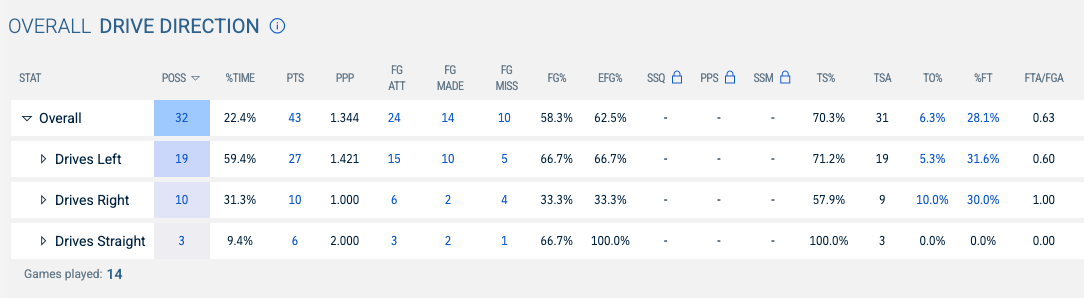
Despite a monstrous 22.4% drive frequency, Boozer couples hyperefficiency with low turnovers and tons of drawn fouls. Outlier driving proficiency with high level touch (77% FT on the season, 80% FT in AAU) leads me to believe that Boozer is a future NBA wing hiding in plain sight.
Boozer will never be highly fluid or explosive, but at a certain point, he scores efficiently while contributing to every other facet of offense. Specifically, Boozer has not missed a beat with his ancillary production, as he’s crushing on the glass and taking tons of 3s while drawing fouls. Sustained ancillary production with high scoring burden is the most surefire indicator of upside.
Despite a massive 32% usage rate against top 120 teams, Boozer has effectively blended scoring efficiency with absurd passing. It’s rare for anyone listed at 250 pounds to come close to this passing volume, but Boozer is doing it with remarkable turnover avoidance. And he’s continued his youth rebounding dominance.
In fact, Boozer’s blend of passing and rebounding is already unheard of for a player with perimeter utility, with the only other comparison being a particular Draymond Green.
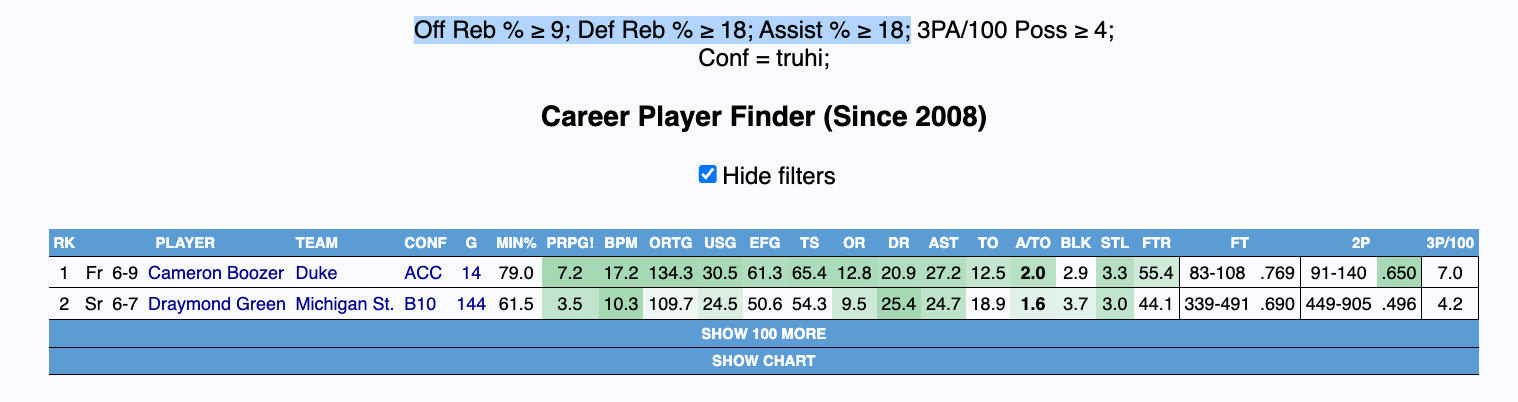
Not convinced? What if we run the same query, and swap 3PA/100 for 3P rate so that we can include internationals. Boozer is ~ 28 3Pr so we’ll set the baseline as 25 3Pr.
Well, the only other drafted player across any league to hit 9 oreb/18 dreb/18 assist/0.25 3Pr is Nikola Jokic.
Is Boozer the next Draymond or Jokic?
Probably not. He doesn’t have the size of Jokic, as Jokic is 6’11 with a 7’3 wingspan. Like Boozer, Jokic was listed at 250 pounds during his draft year, but Jokic has since ballooned to 280 pounds. Such a bulk would enforce Boozer’s dominance on the glass and improve his rim scoring, but I’m unsure how possible this is.
Boozer doesn’t have the defensive versatility of Draymond either, as the difference in block rate is telling. Draymond is one of the best defenders ever, and has been able to play the 5 despite unorthodox size by virtue of his ability to match up with bigger centers. His defensive true shooting influence has been amongst the best in the league for the last decade.
Still, it’s clear that Boozer’s traits are HOF-like, and that this blend of cognition and physicality is highly rare. He couples traditional box score production (elite BPM, offensive rating at usage, etc) with elite cognition and touch.
Boozer is one of the best prospects ever.
2. Darryn Peterson
Not too much to be said on Darryn Peterson, who has played just 4 games versus top 120 teams. From my first draft writeup:
Darryn Peterson is also firmly in the mix for greatest NCAA prospect ever … if we were to exclude his contemporaneous competition. He shot 88% FT in AAU with monstrous usage. He also averaged 4 stocks/game. Never have we seen this before.
Darryn’s offensive upside is strong, but he has some weaknesses. He is somewhat midrange reliant in the halfcourt, his shooting percentages trend on the lower side, and his assist to turnover rate is lower than Mr. Boozer.
Darryn’s steal rate hasn’t quite been there, but he has continued to showcase strong touch and defensive proficiency. His assist to turnover rate is still lower than Boozer, but his shooting percentages have been quite good in low sample. He has also taken more shots in the midrange than at-the-rim. This is certainly not incriminating but it has tanked his free throw rate to under 30 FTA/FGA.

Hard to make too many conclusions from a 4 game sample against top 120 teams, but I’ll be watching Darryn’s rebounding, foul drawing, and steal rates as he recovers.
3. AJ Dybantsa
Dybantsa has been as advertised. He’s one of the best scoring prospects in recent memory. From my pre-season draft notes:
Dybantsa is getting underrated. He is a prolific midrange scorer with a huge FTR and strong FT%- this sort of touch/physicality combination is consistent with all-time scoring prospects.
I would estimate Dybantsa in the Anthony Edwards realm of prospect, and I would like to believe that I am very high on his upside.
However, his mediocre feel stands in stark contrast to Darryn and Booz. “Feel” is an ambiguous thing, but it’s what separates the MVPs from the rest. Jokic, Luka, Shai all had monster A:TO with solid steal volume while still maintaining strong efficiency relative to assisted volume. Players like Anthony Edwards and Jayson Tatum had the latter but not the former. With a sub-1 assist to turnover rate in his final season of AAU, Dybantsa is unlikely to demonstrate the feel to hit MVP-adjacent outcomes, and his ceiling falls closer to these scoring-slanted players.

Dybantsa’s top 120 production has been quite good, particularly with his volume scoring. 59% TS on 31% usage is incredibly good for any prospect, let alone a freshman against top 120 teams. However, his feel has also been fairly mediocre, with just 1.0 A:TO and 0.5 block%/1.5 steal%.
There’s been much talk about the usefulness of stocks, and how they don’t effectively capture defensive impact. That’s fine, but I use stocks and A:TO as an indication of cognition, which is the ultimate driver of improvement.

Moreover, Dybantsa’s scoring profile has been more pedestrian, with low 3P volume and a mediocre efficiency at the rim. Dybantsa is creating at a huge clip, which is highly pertinent, but inefficient shotmaking is not particularly useful either. He’s drawn tons of fouls at every level of competition, but I’m keeping an eye on Dybantsa’s free throw percentage.
If Dybantsa were to get his free throw percentage in the 80s, he would be able to activate far more pathways to true star impact. Scoring efficiently will get you lots of All-Star berths, but strong cognition and application of physicality is what delineates superstar impact. Since that is unlikely, the next best way to get impact is by touch-maxxing. Tatum was such an impressive prospect because he coupled efficient shotmaking with stocks (3% block+2% steal!) and touch (85% FT).
TS% without ancillary impact is a difficult value proposition, and it can lead to less enviable outcomes like RJ Barrett, Paolo Banchero, or Carmelo Anthony.
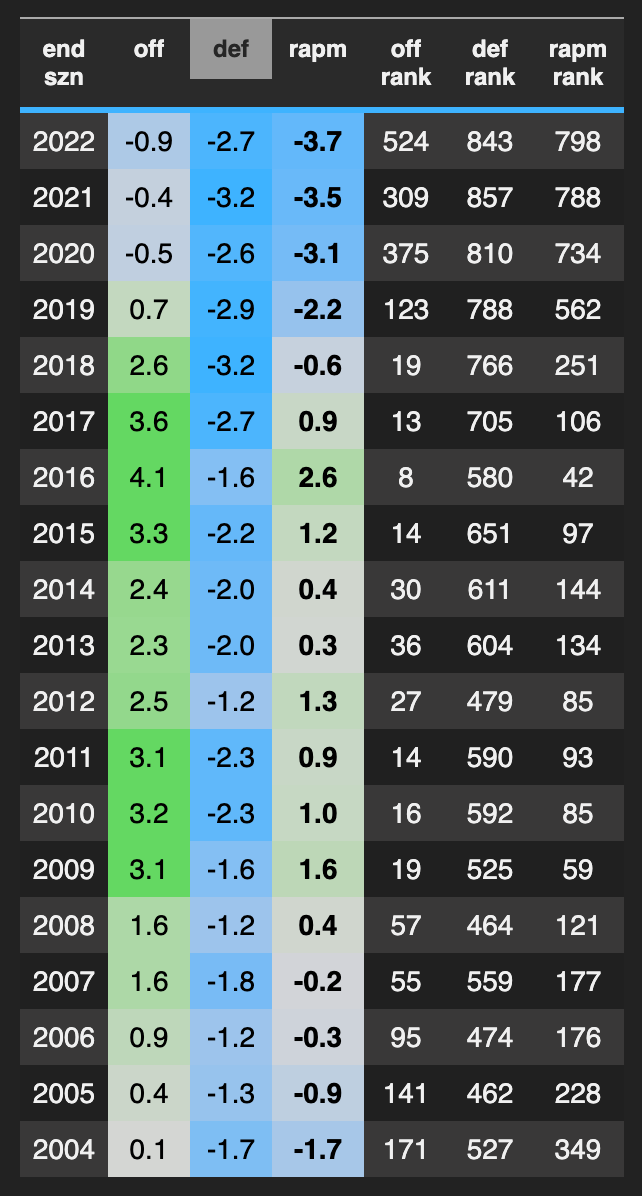
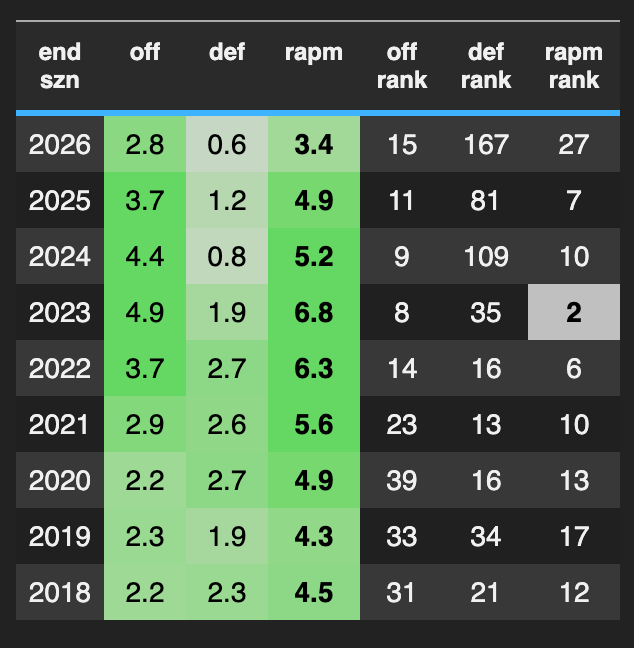
Dybantsa’s creation is just silly, and it gives him a super strong floor on offense. I struggle to see how Dybantsa can really bust, and believe that he will be one of the better scorers in the league from the second he enters. He’s driving and making pull-ups at a very high clip, and I’m impressed by his passing flashes.
Improved ancillary production or touch will give him outs to even higher upside, but lack of improvement will cap his ceiling.
4. Tyler Tanner
No, I’m not a Vanderbilt alumni, I’m not engagement farming, and I’m unfortunately not on anyone’s payroll.
And no, this is not an overreaction to his sophomore year. In fact:
The only high major freshmen ever with A:TO > 2, steal% > 4, and 1 dunk: Tyler Tanner and Reed Sheppard.
The only high major freshmen ever with A:TO > 4, steal% > 2, and 1 dunk: Tyler Tanner and Tyrese Haliburton.
Not drafted freshmen. Overall. And obviously, no freshman has ever come close to Tanner’s combination of 4 A:TO and 4% steal rate.
It’s such an insane integration of cognition. No one has even hit 3.5 steal/A:TO for their career.


It’s very difficult to poke holes in Tanner’s production. He leads all underclassmen in box plus-minus against top 120 opponents (yes, he’s ahead of Cam Boozer), but more importantly he’s doing this with incredible touch improvement.
Going into the year, Tanner’s biggest hole was shooting. He shot just 27% from 3 and 75% from the free throw line, and had similar splits in AAU. However, Tanner has made 87% of his free throws and 43% of his 3s to start the year. 3P makes can be prone to variance, but that free throw leap is highly intriguing. Strong cognition and touch is a superstar pairing.
Tanner’s statline versus top 120 teams is just absurd.

He’s over 35 FTR and 3PR (which is an important difference from last year), and he’s mimicked his 4 A:TO and 4% steal while doubling his assist rate. This is one of the most efficient passers of all time! 2% block at this height is Reed Sheppard-like, and he’s doing all of this at an absurd 68% TS clip. Again, this is limited to just the top 120 teams in the nation.
It really just gets to a point. If he falls off from this significantly, I will act accordingly. But better-than-Boozer BPM with strong defensive rebounding, elite cognition, and hyperefficiency inside and outside the arc needs to be respected, and it gives him all-time upside.
The players below him are special in their own right, but I cannot ignore Tanner’s generational cognition.
This blend of passing, steals, and touch with some degree of physicality is so promising. If the Bart era isn’t enough, we can go back several decades via stathead.
The only drafted underclassmen that shot 80% from the line with 6 assists, 2 steals, and 0.5 blocks per 40:
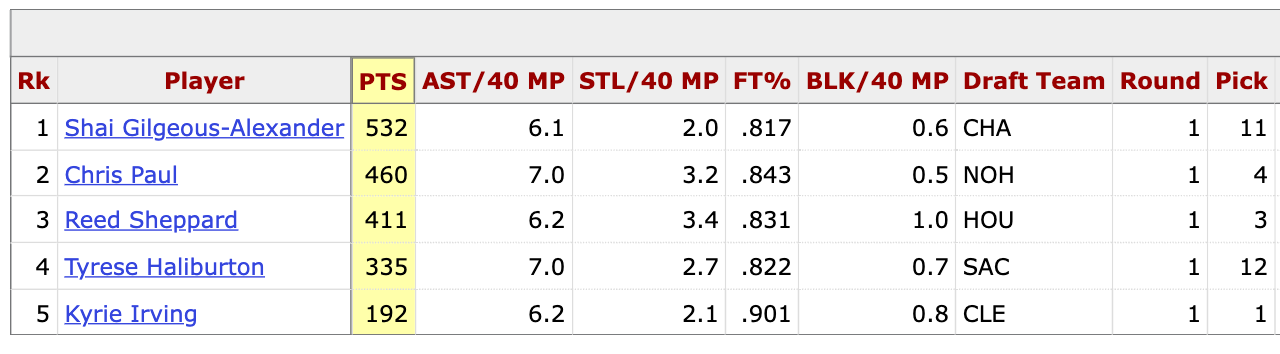
Tanner is at 7.5 assists, 3.4 steals, 0.9 blocks, and 87% from the line; he is well over these thresholds. Even if we drop the assist threshold from 6 to 3 assists/40, we get some notable names:
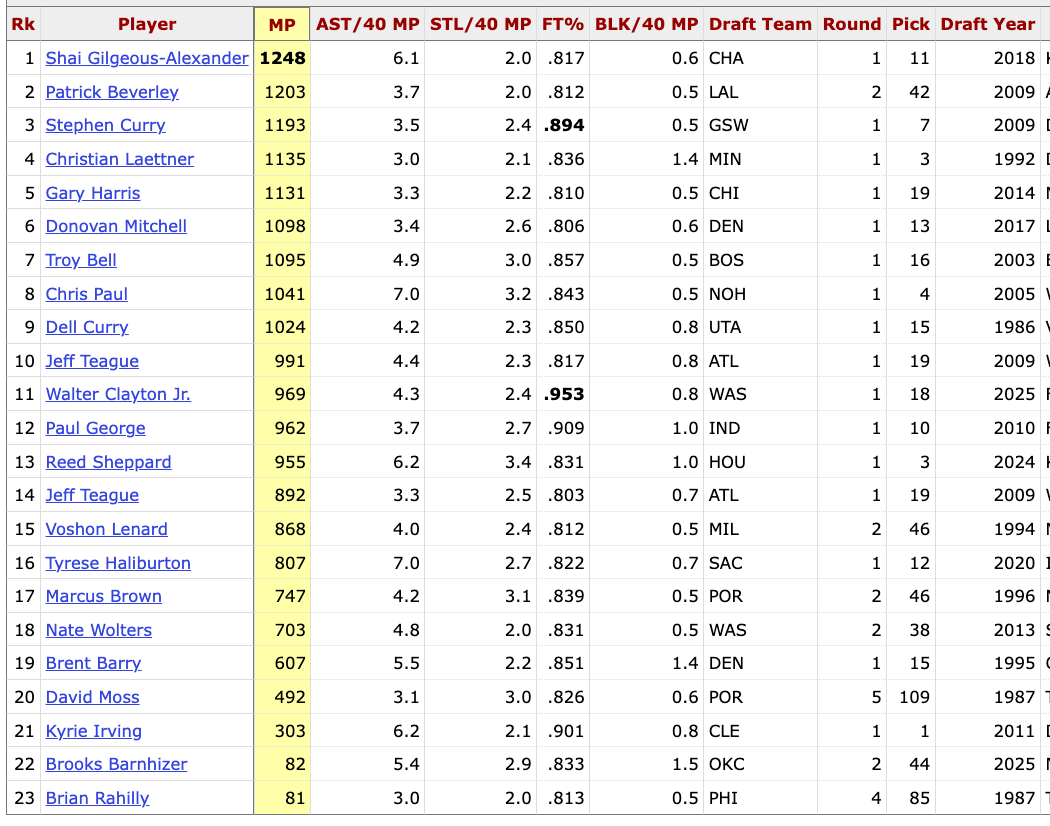
Sure, there’s nothing here approximating these players’ handle or their effectiveness inside the arc or how many points they average. This is reductive, but it’s intentional: it’s pretty incredible how a blend of cognition and FT% with a blocks filter pinpoints some of the most efficient offensive players in NBA history. Tanner appears poised to join these players. He isn’t self creating as many points as some of his peers, but he crushes these filters effectively enough to give him all-time upside.
There’s players on this list that are quite good and will end up multi time All Stars. I’m hunting for huge all-time upside though, and Tanner’s special strengths make him worthy of this ranking to me. His weaknesses aren’t nearly as concerning as some of the players listed below, and his upside is sky high.
5. Caleb Wilson
Caleb appears poised to hit the vaunted offensive rebounding/assists/stock query, and it gives him both a strong floor and fascinating ceiling.

I’ve been especially impressed by Caleb’s rebounding goodness, as that defensive rebounding is a star signal in itself. Moreover, Caleb’s cognition for size is quite good: you don’t see 6’10 players with higher assist rate than turnover rate, or 3% steal. Wilson’s steal rate is even more impressive considering that Hubert Davis’ UNC teams typically rank very low in forcing defensive turnovers.
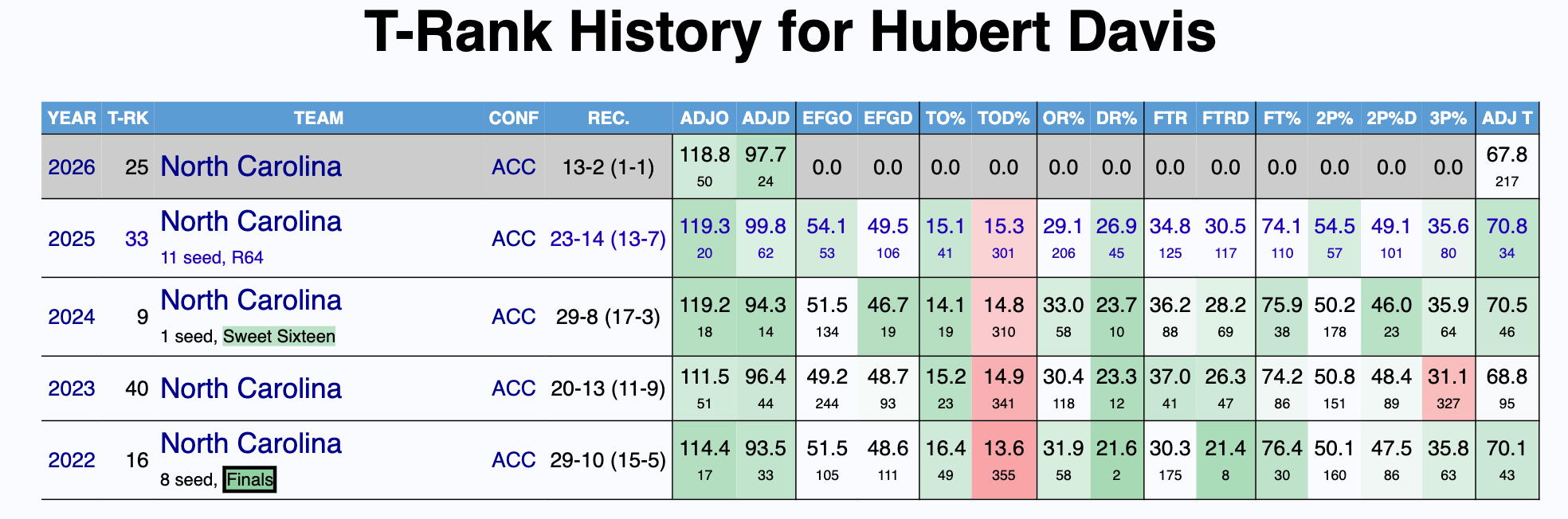
Caleb is listed at 6’10 and 215 pounds, and previous measurements have him around a +3 wingspan. This precludes any comparison to Kevin Garnett, who had a 7’4 WS and had an extraordinary influence on opponent true shooting (a hallmark of elite rim protectors). I project Caleb to be a more effective forward than center, particularly as he sports a 1.9% block rate versus top 120 teams.
Caleb is quite trait maxxed, but his scoring upside seems limited.
In the 2023 EYBL season for the Georgia Stars, Caleb Wilson shot 45% at the rim (20th percentile relative to all EYBL players), with an atrocious 35% layup conversion rate (9th percentile). Caleb is born in 2006, so these were his correctly-aged peers.
In the 2024 EYBL season for Nightrydas Elite, Caleb Wilson converted 74% of his rim attempts (97th percentile), while converting 62% of his layups (84th percentile).
Caleb went from a 32.3% creation frequency in 2023 to a 4.4% creation frequency in 2024. He scored far more in transition (went from the 12th to 67th percentile in transition frequency), and the volume of these unassisted looks allowed his rim finishing to increase greatly.

Caleb is shooting just 49% on layups, which ranks in the 10th percentile nationally. This is somewhat concerning, because his creation frequency is 8.1%, which is extremely low for a wing and much more in line with a center. Even with his dosage of postups, Boozer doubles Caleb’s creation frequency at 16%.
Moreover, Caleb is shooting just 44% (0.77 PPP) on drives, which would rank amongst the lower quartile of prospects that I have data for.
Caleb has made many pullup 2s, but this is typically noise and not nearly as strong of a signal as creation frequency or touch. Caleb’s free throw percentage should improve, but he hasn’t made any 3s versus top 120 teams, his finishing is extremely poor for a center, and his creation frequency is low. Moreover, the last time that Caleb was used as a high octane creator, his efficiency was horrific. All pertinent evidence indicates that Caleb’s ceiling as a creator is limited.
That’s totally fine, because strong ancillary production is far more important than scoring ceiling. Also from the notes:
I believe that Caleb’s combination of elite size and cognition is reminiscent of Herb Jones, a plus/minus demon in the NBA.
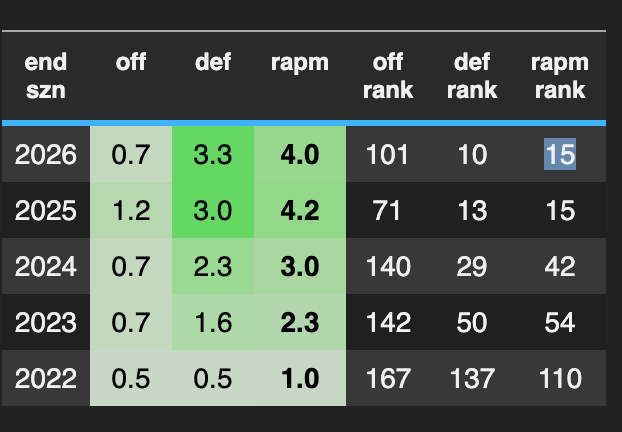
All things considered, Herb Jones was a very weak prospect. Caleb is more productive as a freshman than Herb was as a senior, so a much better Herb Jones is quite the player. Caleb should be one of the best passing and defensive wings in the league, and his offense will be useful so long as 1. he starts taking threes and 2. his drafting team doesn’t use him as a high octane creator.
6. Kingston Flemings
From my draft notes:
This is probably my most controversial ranking. I get the concern, but there is no reason to mitigate risk on a pre-season board.
Kingston has the best stats in the class outside of the big 3. Just in terms of numbers, he has everything. He has a strong FTR, great steal rate, tons of rebounds, great passing, great 2P%, and tons of made FTs. The sole conceivable weakness in the statline is lower 3Pr, but Kingston makes his 3s and shoots career 85% FT, so I do not really care about this.
He played on the Puma circuit, and it’s fair to wonder how legit his production is. I wonder this too. But it feels ridiculous to not even rank this guy first round when all he’s done is produce. He has such a well-rounded distribution of stats, and now we’ll see how legit it is.
It is pretty incredible to look back on how Kingston was rarely on pre-season draft boards, as his stat dominance has continued. He has the second highest BPM versus top 120 teams amongst freshmen (second to, of course, Boozer).

Kingston’s well-rounded production is highlighted by his absurd cognition. Nearly 2.8 A:TO and 5.1 steal rate is not only corroborated by his pre-NCAA sample, but if continued, it puts him in Reed Sheppard/Tanner territory.

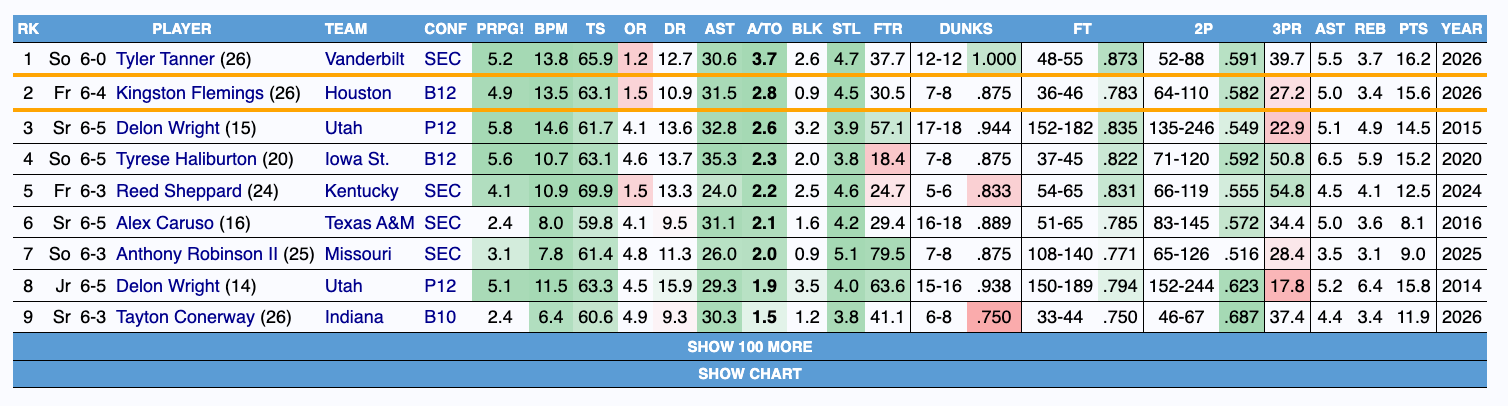
At 6’4 190 with stupendous athleticism and strong feel, Kingston projects as one of a high impact guard in the NBA.

Still, Kingston’s scoring profile raises important questions. The biggest concern is that Kingston does not project to be particularly good from any area of the floor. He’s at the disappointing intersection of poor free throw rate and low 3P rate, which is historically bust-laden, and he’s been unable to convert midrangers and free throws in higher leverage.
Making FTs at a high clip would solve much of this, and Kingston did shoot 84% from the line on a huge pre-NCAA sample. A potential analog is Tyrese Maxey, who didn’t draw fouls or make 3s particularly well, but leveraged his high tier touch to eventually become one of the best 3P shotmakers in the NBA.
Without high tier touch, Kingston may have to rely on 2P shotmaking for value, which does not appear to be as viable of a path given his 2P percentages.
Kingston is one of my favorite players in the draft, and I’ve pondered ranking him much higher. One reason I haven’t is because I haven’t been that impressed by his handle. Two important eye-test traits of Maxey were his ability to make deep 3s and his tight, despotic handle. His handle allowed him to create a high proportion of 2s but also to take an absurdly high rate of floaters. Just 2.7% of Kingston’s shots have been floaters, which is well below average for a guard. The potential for mediocre touch and poor floater conversion is somewhat Dylan Harper coded.
Making more runners and floaters would quell lots of these concerns, and it should be noted that Houston is a context where most guards struggle to even get to the rim, let alone garner respectable foul drawing rates.

Kingston still has pretty clear offensive engine upside if he positively regresses towards his pre-NCAA sample, and even if he doesn’t, he will return strong possessional impact. He is easily one of the premier guards in this draft.
7. Patrick Ngongba
Another one of my pre-season favorites, Ngongba has continued to dominant for a Duke team with underwhelming guard play.
Ngongba is 6’11, 250 pounds, and a reported 7’4 WS. His physical and finishing profile (75% at the rim for NCAA career) make him a surefire lock for NBA production. Throw on some of the best passing that we’ve seen for a player at this size, and Ngongba is firmly in the mix for highest integration of feel and mass ever.
Ngongba’s hand injury may be the reason for his recent free throw badness, but my bigger concern has been Ngongba’s lack of defensive rebounding. With just a 13% defensive rebounding rate against top 120 teams, Ngongba’s all-in-ones have suffered. 3.9 PRPG and 9.4 BPM versus top 120 teams is quite good, but not as good as I expected from a player of his ilk.
No centers have put up this sort of defensive rebound rate, which is a worry but not too high on the priority list for a center. He’s made 75% of his rim attempts versus top 120 teams, with a 40% dunk rate. This is good for a monstrous 68% TS versus top 120, and he’s somehow at 71% TS for his career.

Ngongba also couples an 85 FTR with 24 3PR, which are both well above average for a center. His offensive usefulness is even more compelling considering his silly cognition. What kind of big has both 1.6% steal rate and an assist rate higher than their usage rate?
I previously noted that his profile was somewhat similar to Jokic.

Those stats were from Jokic’s age 19 season, and Jokic’s age 20 season was even more ridiculous than that age 19 season. Ngongba isn’t really close to Jokic as a prospect, but it’s nonetheless an interesting combination of physicality, touch, and actual mass.
Still, this combination of outlier cognition and physicality is highly pertinent, and he’s been taking more 3s. I’ve been impressed by his movement, as he moves decisively and attacks space deliberately. His fluid movement style is unlike most 250 pound bigs, and it seems to give him upside as a driver.
With strong passing, elite physicality, and improving perimeter touch, I wonder if Ngongba can mitigate his defensive rebound badness by playing more as a forward. There is pretty much no statistical imprint of creation anywhere in his profile, but his movement style and trait integrations indicate that he could develop in unorthodox ways. At the least, he should be a serviceable big, but I’m interested by his unorthodox upside.
8. Yaxel Lendeborg
Yaxel has been just comically dominant this year. He’s been the best player in the nation, leading in BPM and RAPM (against top 120 teams and overall).
Not only has he not a single weakness, pretty much every statistical category can be contrived as a strength. His rebounding and stocks have been elite, his passing is incredibly efficient, and he’s made a clear touch leap.

All green. 20 BPM versus top 120 is just absurd. The highest amongst drafted players were Zion (18 BPM) and Steph (17 BPM). Yaxel is really doing his best impression of Zion 2P dominance and Steph touch. 3 A:TO and 3% steal is unbelievable cognition, and he’s doing it with center-like blocks and rebounds. He’s even at 1.2 blocks/foul, which would put him in shouting distance of queries like

The issue is that Yaxel is a super senior, with a September 2002 birthday. His senior production was good, but far more pedestrian.


In particular, Yaxel’s scoring stats improved drastically. Going from 49.7% 2P to 76.6% 2P is quite the leap, and he’s also tripled his 3P rate while making far more FTs.
I can buy a touch improvement, but I think playing the 3 with lower usage in the May system has allowed Yaxel to score far more efficiently inside the arc. We’ve seen similar 2P improvements with Morez Johnson, Aday Mara, and even Danny Wolf and Vlad Goldin last year.
Still, Yaxel’s cognition indicators were wildly good both last year and this year, and they are even more impressive in light of his center-like mass. Yaxel is 6’9 with a 7’4 WS, and he weighs 240 pounds! He is built like a center, but passes and steals like a guard. If he’s going to shoot like a guard too, then he’s going to be a strongly positive player, with sneaky upside in spite of his age.
Worries about his age are fair, especially with his strong improvement from age 22 to age 23, but it’s rare for older players to combine interior domination with feel. My working comp for Yaxel is forward Derrick White.
9. Joshua Jefferson
Jefferson may be hiding in plain sight.
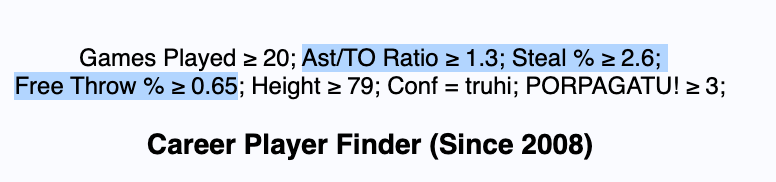

Productive forwards with strong feel and decent touch don’t really come around too much. Jefferson has by far the highest steal rate of the group, but he’s also the 2nd most efficient on 2s with the 2nd highest height. In a cognition-mass paradigm (ie my proposed cognition-mass index), this is especially impressive.
Jefferson is listed at 6’9 and 240 pounds, which is huge for a forward. Even the burly Draymond is listed at 230 pounds. His functional and actual mass are both clearly good.
Jefferson has really ramped up his on-ball load this year, with 29% assist rate and 29% usage vs top 120 teams. Both are far higher than his career averages, but the premier usage-adjusted offensive rating metric still rates him highly (5.7 PRPG).

Still, Jefferson’s offense has regressed with this usage, as he’s down to just 52% eFG.

50% 2P is pretty bad, but he won’t shoot 22% on long 2s forever, especially as he’s shooting a strong 41% on long 2s for his career. It’s nice to see that Jefferson is getting up more 3s, as his touch was too good for this not to happen eventually.
Nothing too novel here. Jefferson is a high impact wing without the scoring chops to sustain high usage, and at high usage, his scoring efficiency has predictably declined.
There’s not much more to discuss. His weaknesses are limited.
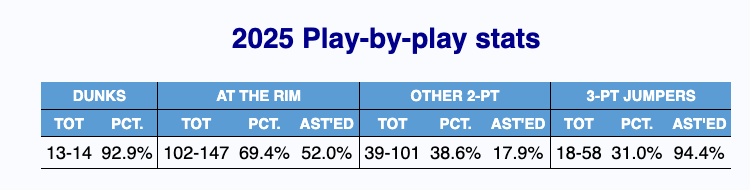
Jefferson’s midrange goodness has largely come unassisted, which is pretty impressive relative to most forwards.
One interesting development is Jefferson’s improved driving. He’s always driven at an outlier rate (23% drive frequency last year and this year), but he’s doubled his efficiency from 0.55 PPP (one of the worst high volume drivers in basketball) to 1.01 PPP. It’s one of the most impressive developments in college basketball, and it could give him real on-ball upside in the league.
Jefferson has been good for a long time. His AAU ancillary stats were standout, his freshman year was quite good, and he’s on pace to rack up career 10+ BPM, which very few have maintained over 100 games. It’s even rarer for more perimeter-oriented guys.
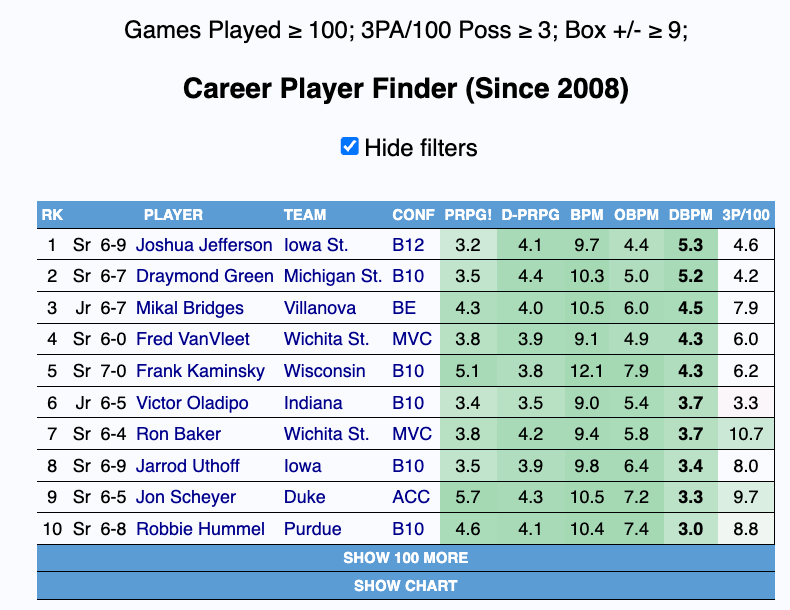
Guys with this type of long-term offensive and defensive impact don’t really come along that much. This is one of the most productive college players of our lifetime, does pretty much everything you’d want, but his scoring is a bit weak. This is the exact type of profile that will get underrated by NBA teams, and it is the exact type of profile that’s a pretty good bet for long-term impact.
I haven’t seen anyone put Jefferson this high, but I’m a bit worried that he may be too low. It’s an unsexy profile but one with few holes. The fact that Jefferson is barely top 10 is a testament to the strength of this class.
10. Jayden Quaintance
From my pre-draft writeup:
He needs to finish better, and he needs to make FTs. Otherwise, we will continue to see poor TS% seasons, and I cannot condone poor scoring efficiency from my big. There is simultaneously fascinating upside and feasibly downside.
With little sample size, I basically feel the same. He has a fascinating intersection of traits, and now he’s listed at 6’11 and 250 pounds. He just needs to actualize his potential with some sort of high end production.
11. Bennett Stirtz
Stirtz is a highly efficient creator with strong turnover aversion. It’s a rare mold.

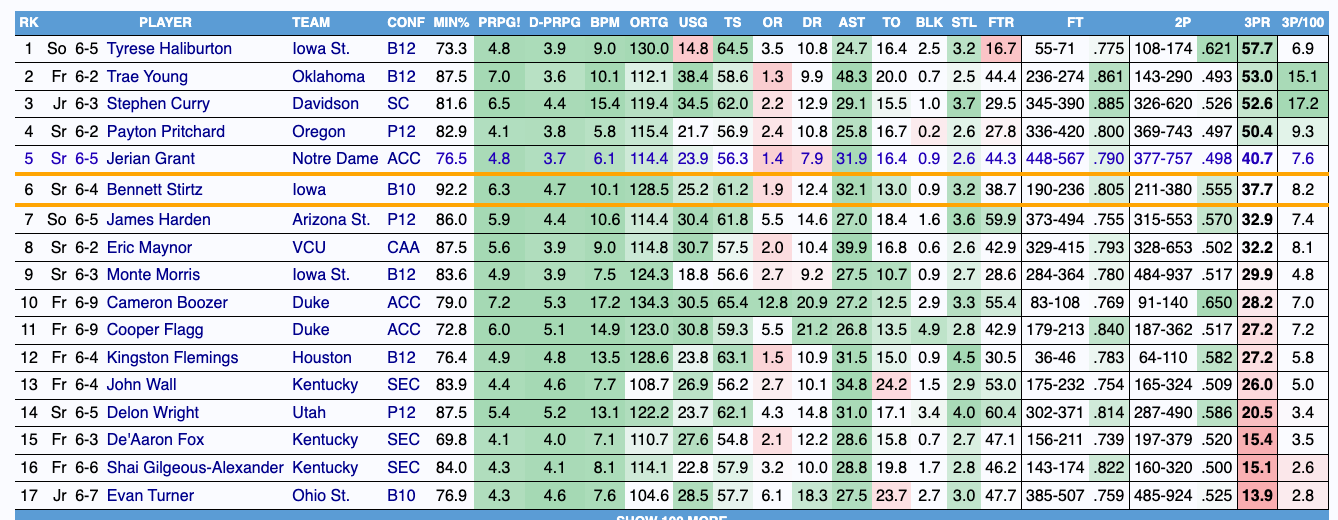
You could come up with endless queries for Stirtz, as he doesn’t really have a clear weakness in his profile. He’s one of the best CBB guards of the last decade, in both D1 and D2. He finishes and dunks! He makes 2s and FTs. He steals and passes while drawing fouls. So many integrations dripping in upside.
Still, much of this is carried by his remarkable junior season at Drake. From writeup:
Stirtz is coming off arguably the highest feel season in the history of Barttorvik (volume-adjusted), and this sort of creation profile cannot be ranked any lower despite his age or lack of meaningful positional size. Keep an eye on his A:TO and FT%, as he will face more pressure but will likely have a lower load (the guy is coming off a season where he played basically every minute).
As expected, Stirtz’s passing and creation is down. Against top 120:

60% TS on 26% usage is pretty phenomenal, but it comes largely from making an outlier high rate of 3s. With hugely diminished offensive rebounding, blocks, and finishing, Stirtz’s athleticism indicators are concerningly low.
He’s still playing a ridiculous proportion of team minutes, and his season at Drake cannot be entirely ignored. These sorts of inefficiencies are concerning, but regression towards his Drake sample has to be expected somewhat.
This is just such an attractive mold that some of these warts can be swallowed or handwaved for positive regression. Creators who can dunk, pass, steal, and shoot on micro-assisted rates are just exceedingly rare, and they are worth taking a risk on even with warts.
However, if this badness continues, then we will drop him further.
12. Dailyn Swain
Swain is the most efficient driver in the class, and his career passing x steals has always been standout for size. Throw on a career FT% since 2021 and this is one of the best blends of cognition, physicality and touch that we’ve seen at wing size.

More of my thoughts on Swain can be found here:
13. Daniel Jacobsen
Jacobsen is next in a long line of Purdue bigs. He is listed at 7’4 and 250 pounds, which he pairs with impressive touch.
His passing is poor, but Jacobsen’s blocks and finishing at 7 foot size makes him a pretty easy NBA bet.
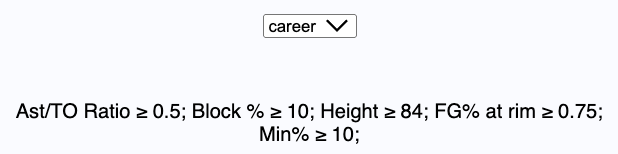
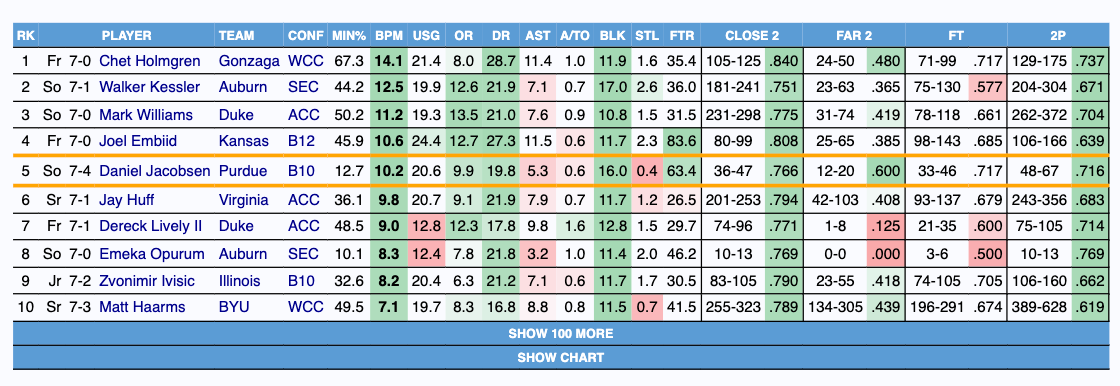
If he still qualifies for this under a larger, more stabilized sample, it’s pretty hard to argue that he isn’t an obvious NBA player with DPOY upside.
There’s some flaws, as I outlined.

Jacobsen has been far better in two big lineups, as his rebounding (and general offensive influence) falls off a cliff in lineups without Kaufman-Renn. There’s a possibility he’s a bit of a Painter merchant, although his size gives him such large margins for NBA translation that I’m not too worried about it.

It’s pretty interesting how much Jacobsen’s assist rate, Foul rate, and 3P rate go up without Kaufman-Renn. This could be an indication of things to come for Jacobsen next year. Still, Jacobsen has been objectively bad without Kaufman-Renn, and it will be interesting to see whether he can improve his impact in those minutes.
14. Mikel Brown
It has been difficult to find a reliable sample to evaluate Mikel. He’s undergone a notable growth spurt, which explains much of his improved productivity over the last few years. For instance, Mikel shot just 32% on 2s across 24 OTE games in 2024. And just two years later, inside-the-arc shotmaking is a true strength of Mikel’s, as he’s shooting 57% on 2s against top 100 teams. It’s also led to a bevy of eye-popping half court dunks.
Mikel’s shotmaking was standout across his youth career, but it was his blend of foul drawing and 3P volume that was especially notable. It led to fascinating statlines, like at the 2024 Hoop Summit, where Mikel went 1/2 2P and 0/7 3P… and scored 17 points by virtue of making 15/18 FTs. 200 FTr and 80 3Pr is pretty ridiculous stuff in tandem.
One of my biggest worries about Mikel was his turnover proneness, as he barely mustered a 1 A:TO in his final AAU season. That AAU season was also notable for his lack of functional athleticism, with just 0.5 combined blocks and offensive rebounds. Mikel has somehow entirely eliminated these turnover issues, although he currently has just one combined block and offensive rebound all season.
This isn’t quite an ancillary issue. Mikel has clearly good feel, as evidenced by strong assist rate and A:TO, and I would expect his steal rate to rise given that he averaged 1.5 steals per game in AAU. It’s an issue of misalignment between his physical and statistical footprint: Mikel clearly has the physical athleticism to dunk and finish, but he does not exhibit the functional athleticism to get blocks and rebounds.
Rebounding or block improvement is rare, and it will likely lead to low defensive impact for his career. However, his offense theoretically covers everything you would want from a “lead” guard. He dunks, finishes, takes 3s while drawing fouls, and he passes efficiently.

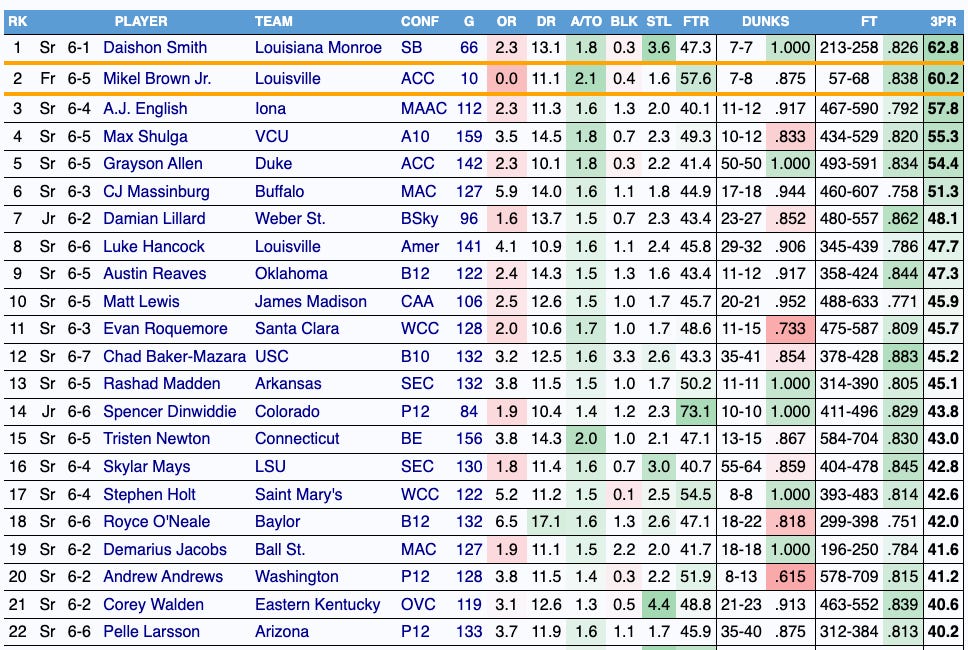
Mikel’s combination of dunk rate, 3Pr, FTr, and passing is pretty outlier, but so is his utter lack of blocks and offensive rebounds.
While there is some small chance Mikel’s stocks can improve given his strong cognition and actual physicality, it is fairly likely that Mikel will be a defensive liability throughout his career. Mikel’s offense is very high variance, making this an even murkier proposition.
With his high initiator upside, Mikel is a reasonable bet within this range.
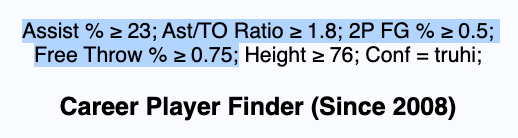
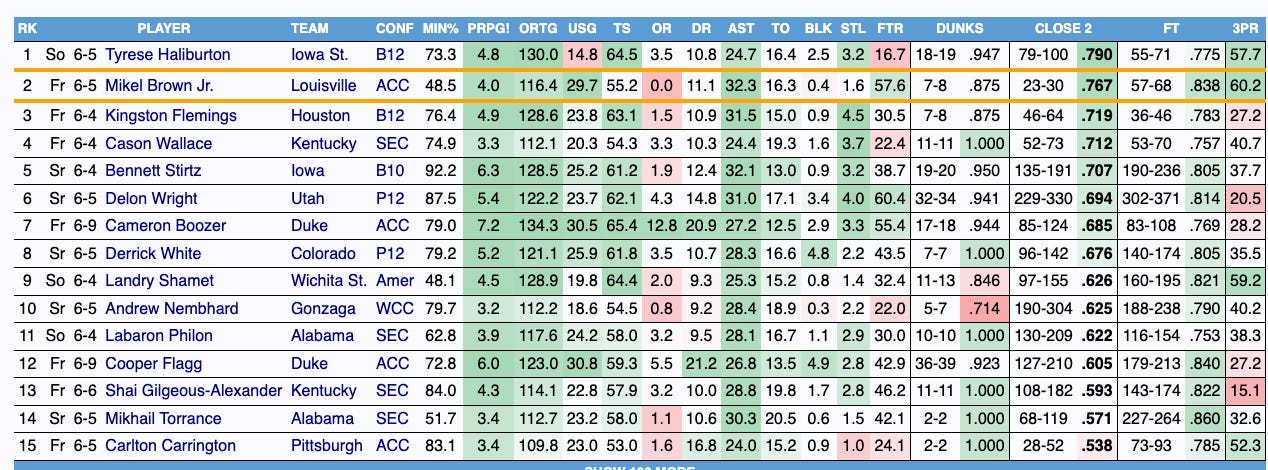
The company is nice, but it’s clear that Mikel lags behind in critical areas while lapping the field in others. It is a high variance profile that I would understand fading given the lack of statistical physicality, but the upside is strong enough for me to stay interested.
15. Labaron Philon
I could use that same query to highlight Labaron’s viability, but he’s a bit too close to the FT% threshold for my liking (filter is 75%, Labaron is career 75.3% FT). If we drop the filter we get the following:

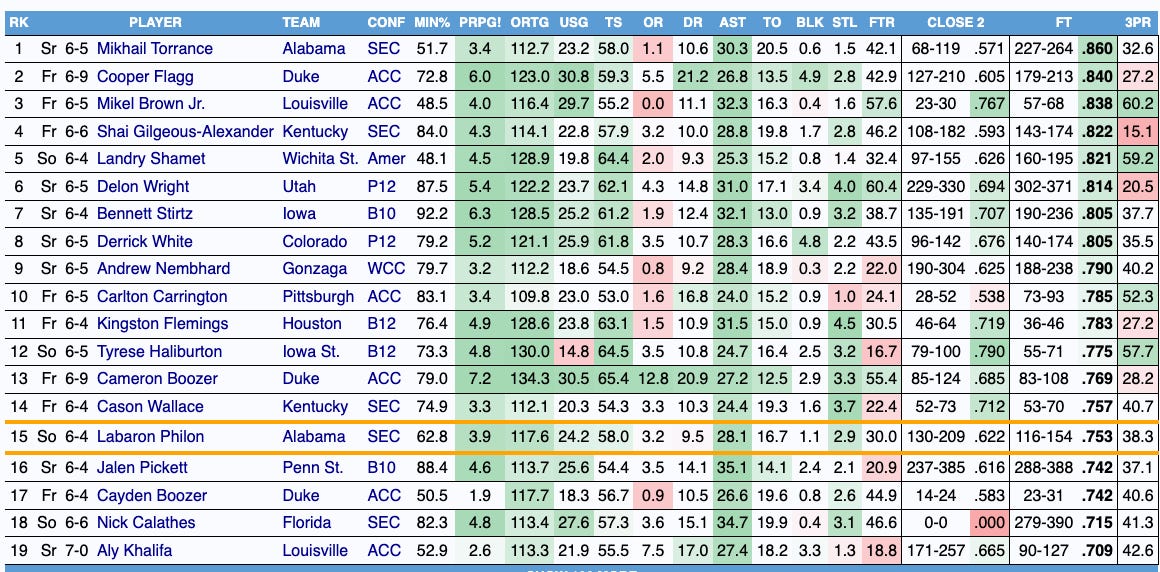
Dropping the FT% filter inserts a number of less flattering profiles. It is fairly intuitive that strong initiator prospects require good touch to score efficiently, but Philon falls in the interesting middle ground of an efficient scorer with mediocre FT% by guard standards. An examination of his scoring profile yields how he’s done this:

Philon has overcome combination of average foul drawing, average 3P volume, and average FT touch by being one of the most prolific far 2 scorers in college basketball. Alas, I would be more comfortable projecting this to the NBA if his free throw and 3P percentages weren’t so low. With newfound variance in his touch outcomes, there is a pretty clear downside avenue where Labaron cannot score as effectively if he’s not prolifically converting far 2 attempts.
These aren’t your traditional midrange attempts though; Nate Oats is one of the most infamously analytically-savvy coaches in basketball, and his teams consistently limit their volume of midrange attempts. Rather, Philon’s shotmaking comes through floaters. Philon has ranked in the 85th percentile of runner frequency in both 2025 and 2026. He’s sitting at 75th percentile runner conversion this year. Runners have important evaluation utility, and it usually indicates a capable handle and PnR proficiency, as it correctly does in this case.
However, another important consideration in “Oatsball” is a ridiculously high team-wide transition rate. A gargantuan 25% of Philon’s scores came in transition last year (90th percentile), and this has dropped to a more pedestrian 20% frequency (55th percentile). However, Philon converted just 44% of his halfcourt rim attempts in 2025, and he is now up to an elite 67% rim conversion rate. It remains a reasonable 57% against top 50 teams. This is one of the most important developmental occurrences amongst prospects.
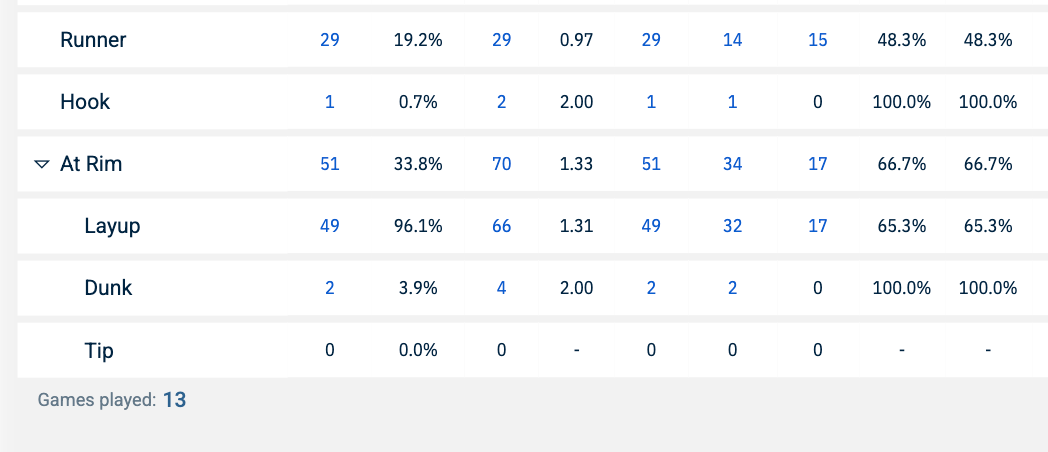
Philon has also converted 39% of his 3s this year, impressive considering more than half are coming off the dribble. In theory, this is a fairly impressive prospect if he can finish and shoot, while passing and stealing at a high rate. Even if he doesn’t have the gaudy FT% of his peers in the prior query, he still has reasonable outs to being a solid NBA point guard.
I would tend to agree, but there’s a few too many red flags that limit his placement relative to the aforementioned guards. Philon’s blend of foul drawing and 3Pr is limited, and his lack of foul drawing is even more notable considering he takes twice as many rim attempts as long 2s… and most of those long 2s are actually just quasi-rim attempts (floaters).
Moreover, Philon’s lack of athleticism or mass puts him in a perilous group. From my Egor article:
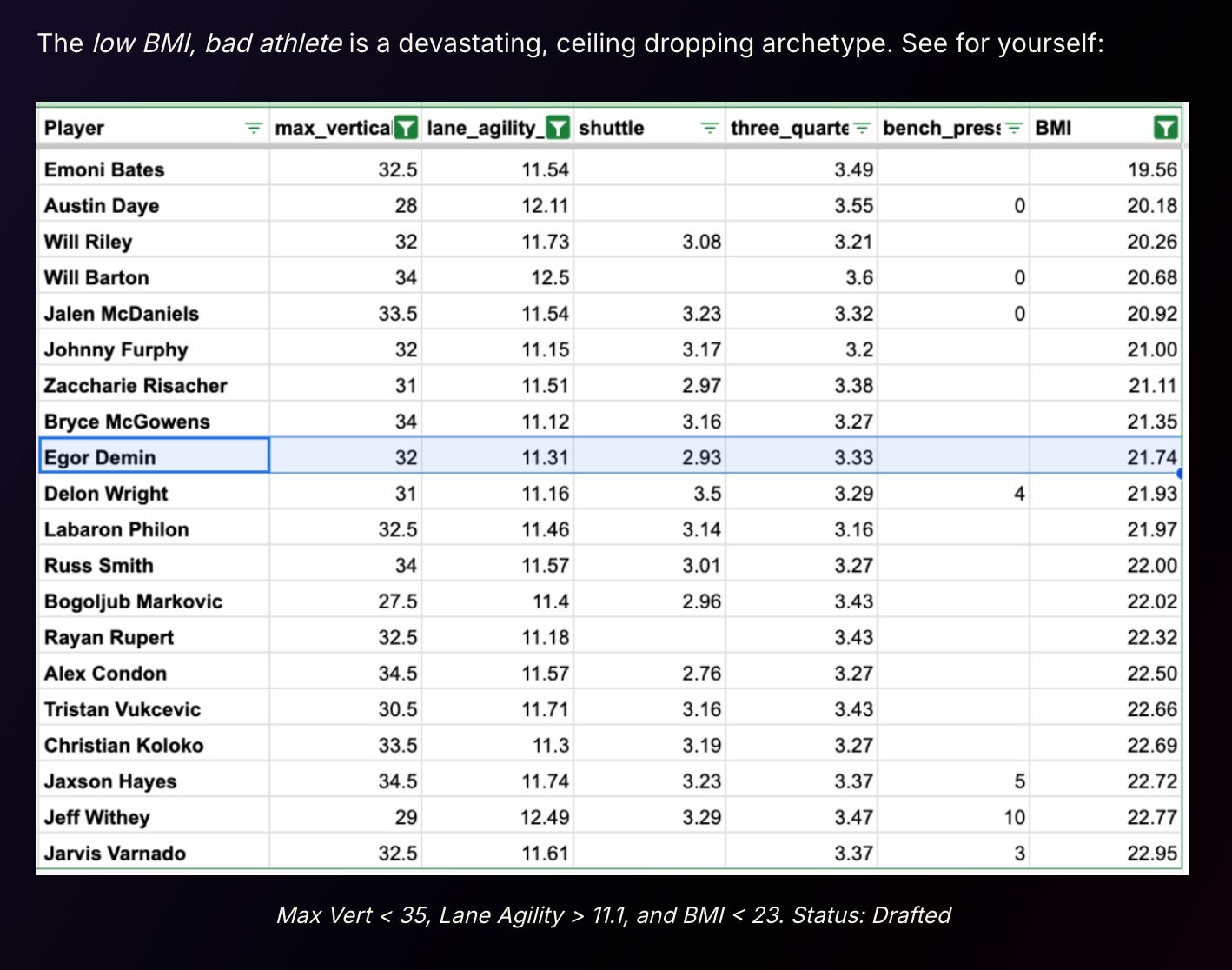
Philon’s 3Q sprint was the fastest here, but he’s not close to meeting the vert, lane agility, or BMI thresholds. Lacking athleticism or mass will make it even more difficult to score at the rim or draw fouls. His rim scoring improvement is notable, but there is an ugly downside scenario that he cannot finish or shoot, while his defense is mitigated by his lack of mass (a fate suffered by the stock-heavy Haliburton). Despite Philon’s tantalizing upside as an efficient creator with strong passing, this sort of downside is too distressing to rank that highly, even if his impact and box score aggregates are near the top of the class.
16. Koa Peat
From my draft preview:
So how is Koa shooting 53% on 2s if he’s getting to the rim at volume and shoot 70% there? The answer is suboptimal offensive process.
Koa neutralizes his elite finishing with high volume, mediocre pullup 2 shotmaking. His 99 rim:78 nonrim ratio is especially bad, considering he scored so many baskets in transition (where rim shots are taken at a much higher clip than nonrim 2s). Koa was at 43 rim: 64 nonrim 2s in the HC, which is so bad. He shot 65% at the rim in the HC, so it’s not a finishing issue; it is simply a midrange reliance issue.
Taking midrangers at such high frequency without requisite touch is a devastating ceiling limiter. If this continues in the NCAA, we will see poor efficiency.
There’s two coin flips here. One, that Koa’s FT% continues to improve. Second, that Koa changes his midrange tendencies. Perhaps these are not both probabilities commensurate to a coinflip, but entertain the concept for me.
If Koa is able to improve both things, he becomes the vaunted 6’8 creator, an archetype that is highly sought after and implies vast upside. This is my board with my rules, and I think this sort of upside is worthy of pre-season t10 rank. Because if it happens, he will be in the top 5, with a chance at usurping the top 3.
If neither of these coinflips occur, it will be difficult to swallow the proposition of spending meaningful draft capital on Koa, and he will fall precipitously on all boards.
Unfortunately, Koa has not improved his FT% or changed his midrange tendencies. In fact, Koa has not made a single 3 this year, largely because of his coach’s insistence that he is not a perimeter player!


With one of the most productive youth careers ever, it’s no surprise that Koa has continued strong production in the college basketball ranks, but its not coming in the ways we’d hope.
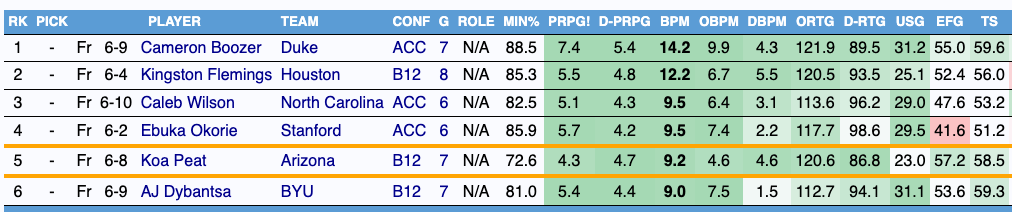

Koa has avoided turnovers, but he has not drawn fouls (38 FTr) as prolifically as we would hope a non-shooter would. Predictably, this is because of his high assisted midrange emphasis.
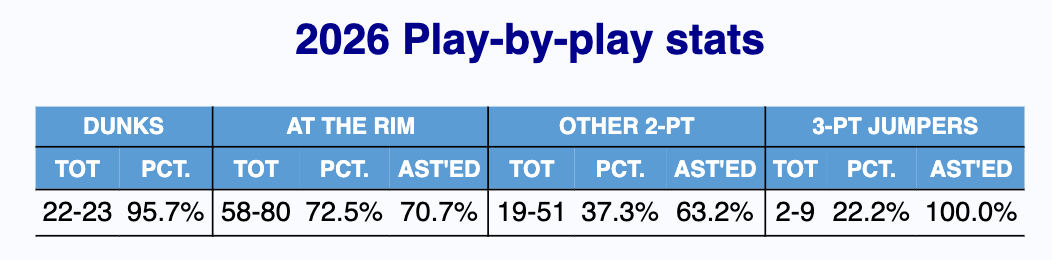
This is such an archaic scoring process, as a 65% assisted rate on 2s without any 3s is emblematic of a traditional center. He is scoring efficiently, with a rim conversion rate higher than his 7’2 teammate Krivas, but it is impossible to make any conclusions based on this sample. Moreover, Koa has not progressed as a free throw shooter at all, making his shooting outlook even more bleak.

Still, Koa has continued to showcase strong feel, as he is up to 1.6 A:TO and 2.2% steal rate. Higher assist rate than turnover rate is somewhat rare for a forward sized player, but not particularly predictive. Some similarities to Stephon Castle?
This is a pretty interesting evaluation, considering the stark differences between his AAU creation and NCAA assisted volume. I would typically fade this type of NCAA statline, but forwards that can pass are decent bets, and it’s not like he’s unproductive. This is probably the lowest I can reasonably put a forward with high RSCI, strong AAU/FIBA production, and good cognition/physicality.
17. Hannes Steinbach
As expected, Hannes has crushed college basketball.
However, Hannes has unsurprisingly struggled to maintain forward-tier cognition or center-tier finishing; he has decidedly not beaten the tweener allegations.



Steinbach has put up monstrous numbers against top120 teams. 6.5 PRPG and 9.4 O-BPM is Cam Boozer-like, and he’s doing it with a ridiculous 67% TS. Again, this is against top 120 teams.
0.5 D-BPM is indicative of Steinbach’s serious defensive limitations.

Steinbach is one of the best rebounders in the world, and he will walk into the NBA as one of its best rebounders from day 1. However, that is the extent of his defensive production, as he sports a hideous 101 defensive rating, spurred by a worrying lack of stocks. Steinbach is a candidate to finish below 1% steal, which is historically a robust bust signal amonst non-shot blocking bigs. In a sea of busts, the sole players that stand out are Julius Randle and Domantas Sabonis. It would be difficult to find draft models that were remotely high on these players at the time.

Steinbach is taller than both Sabonis and Randle, but he’s at least 20 pounds lighter than both (Steinbach is listed at 220, while Sabonis was 240 and Randle was 250). This lack of mass accounts for his poor finishing (66% at the rim).
A comparison to Sabonis may feel intuitive, but their efficiency came in different ways. Steinbach has better passing, but far worse finishing than Sabonis. In fact, Sabonis is one of CBB’s best high volume, postup-oriented finishers in recent memory, putting up 73% at the rim on 150 attempts! The finishing discrepancy makes this a largely moot comparison.
How about Julius Randle? Well, Randle’s numbers certainly aren’t as gaudy (just 56.6% TS, 10 points below Steinbach), but Randle had one of the lowest assisted rates we’ve ever seen from a forward.
28% of Randle’s 2s were assisted, which is nearly half as much as Steinbach (50%). Moreover, Randle was one of the most prolific driving prospects ever (25% drive frequency), while Steinbach is at just 8.2% (albeit with 1.4 PPP).
Without strong finishing or creation, Steinbach’s scoring is harder to buy, even if at 67% TS against top 120 teams. When nearly all of his shots aren’t coming at the rim or at the line, I would expect his below-average finishing to reflect more in his TS%.
Still, below average finishing is not too devastating considering Steinbach’s elite rebounding and touch. I would expect Steinbach to take far more 3s in his prime, and it’s this integration of OREB and 3Pr that could give him long-term staying power.
This is a poor mold, and it may be even worse if he starts turning the ball over at a rate commensurate with his priors. Still, Hannes is one of the most decorated youth producers in Europe, and he’s one of the most productive players in all of college basketball. This feels like a good spot to rank a likely-productive NBA player with high lineup friction.
18. Motiejus Krivas
I first wrote about Krivas in the summer of 2024, where I outlined how his sheer size, athleticism, and FIBA pedigree that made him a clear breakout candidate, even if his freshman profile was not too standout on the surface. It can be found below:
While Krivas’ sophomore season ended prematurely, he’s started his junior season with a bang. Arizona is one of the best teams in the nation, and he’s been an indispensable part of the team’s frontcourt.
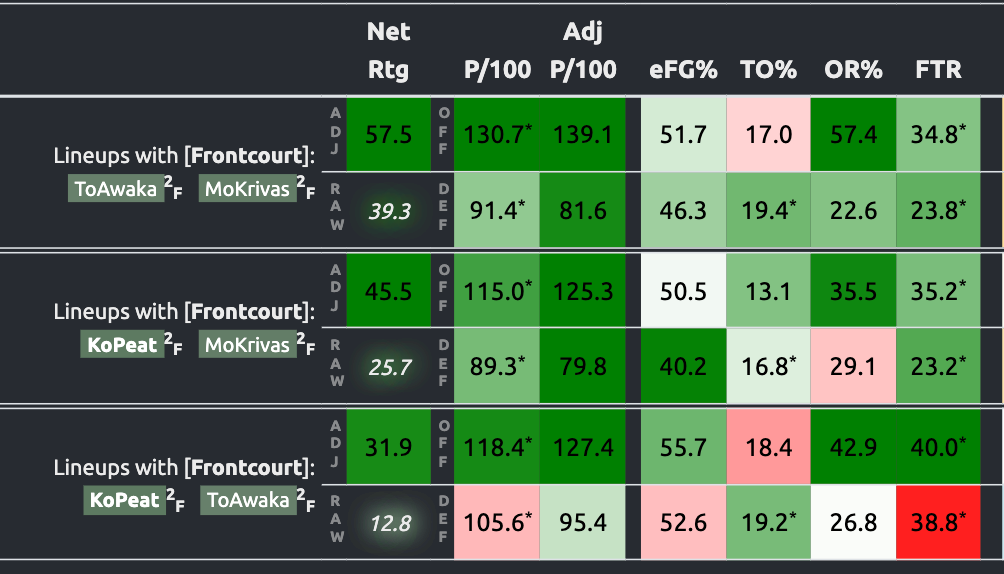
The 7’2 Krivas is the only player on Arizona that’s even listed about 6’10, which likely overstates some of his rebounding influence. But make no doubt, this is one of the best rebounders in college basketball. In fact, Steinbach, Krivas, and Purdue’s Cluff are likely the three best rebounding prospects in high major college basketball by a bit.
To contextualize his rebounding upside:
Personally, I don’t care too much if he shoots or not, since he’s also an absolutely insane rebounder. Krivas is coming off a 14.7% OREB/22.8% DREB season in NCAA: there have been only 9 drafted players since 2008 to match those numbers across their career. It gets crazier: Krivas averages the most rebounds per 40 in the TWENTY EIGHT YEAR HISTORY of the U18 Euros (10+ mpg). His 21.8 rebounds per 40 is well ahead of 2nd place Enes Freedom (20.2), with Usman Garuba (18.6) and Marc Gasol (17.7) not too far behind. Again, pretty much every good Euro prospect has played in the U18 Euros, including so many notable bigs since 1996. It is an absolutely huge deal that he is the most productive rebounder on a minute basis in the entirety of available data for this tournament.
He has similarly crushed the U20 Euros and Lithuania Pro League: he put up an unreal 19% OREB and 28% DREB across 48 games of LKL+NKL. He isn’t a Zach Edey/DeJuan Blair level rebounding prospect given the lower comp level, but Krivas really isn’t THAT far off. Throw on his massive 7’5 wingspan, and Krivas is pretty easily the best rebounding prospect in the class if he declares, and should be one of the best rebounders in the league from day 1.
It may be easy to handwave a 7’2 player’s rebounds as non-standout, but Krivas is legitimately one of the best rebounders at that size. It is highly impressive.
An even more impressive trait may be Krivas’ touch. He is shooting 77% from the line on 150 FTAs in NCAA, while making 42% of his long 2s. Even outside of Arizona, Krivas shot 73% FT during his final professional season in Lithuania (139/191), and he’s shot 70% across his FIBA career (78/112).
A player who gets to the line as frequently as Krivas (career 64 FTr) and makes FTs at a guard-like clip has clear utility. Especially given his reasonable turnover aversion at size (career 0.7 A:TO). Edey is the only seven footer in recent memory that drew fouls, made FTs, and protected the rim to this degree. It would be a mistake if Krivas wasn’t developed as a shooter in the NBA:
Krivas actually has a decent track record of 3P shooting volume in the past: he’s averaging about 1 3PA/40 across 28 FIBA games, and he put up 61 threes across his final two seasons in Lithuania.
This development may be a necessity, as Krivas’ scoring efficiency has been lackluster in the college ranks. He’s converted an abnormally low 64% of his career rim attempts, well below the Mendoza line of 70% that I’ve established earlier.

Some improvement, but Krivas is at just 55% TS against top 120 opponents despite getting to the line at a frequent rate. He is shooting just 50% on 2s in 7 games against top 120 competition, and converting just 62% of his rim attempts. It is difficult to blame context when his 6’8 teammate, Koa Peat, is making 70% of his rim attempts in these same games. Krivas’ strong FT touch and FTr have persisted, but they can only compensate for his limited scoring efficiency to some degree. A 7’2 player with 55% TS is a difficult sell.
Krivas has decent assist to turnover rate, strong blocks, and high steals for size (1.4%). This combination of steal rate, foul drawing, and free throw touch indicates a very high degree of skill, which is notable for his size. However, I wonder the degree to which this can make up for his finishing, considering he is such a poor finisher by center standards.
While neither was as poor at the rim as Krivas, two NBA players with sub 60% 2P but strong rebounding and steals are Christian Koloko and Steven Adams, whose impact on the sheets far outweigh their current perception. Skilled 7’2 prospects with 7’5 WS and 260 pound frames don’t come around too often, and it provides him with one of the highest true upsides in the class.
19. Christian Anderson
Anderson was one of my favorite breakout candidates this year, as his efficient freshman campaign indicated that he would be able to garner a much higher offensive load.

This season, he’s showcased blistering shooting efficiency while scaling up his passing.

26.6% usage and 61% TS is a wild combination, and he’s done it despite missing an outlier rate of free throws. 62% on 2s with a 60 3Pr is special, especially with his rim efficiency.

Anderson has been exquisitely turnover avoidant, but his defense and functional mass is a clear question. He takes a significantly higher rate of midrange shots than at the rim in the halfcourt. Moreover, his defensive rebounding is poor for his size, and he’s not blocking or stealing at a high rate. This combination of poor ancillary production and high level passing/shooting is a common motif in this class.
Anderson will be a highly potent offensive player, and he will be a difficult player to hide on defense given his lack of rebounding, stocks, and mass. His passing and shooting is one of the best in recent memory, and he’s doing it as with true sophomore age (April 2006). Anderson may be an elite iteration of a poor mold, but his offensive upside and robust priors indicate a reasonably useful NBA player.
20. Darius Acuff
Acuff has a large fanbase, and I’m wary of “pissing them off”.
There is no denying that Acuff has been strongly productive, especially against high level competition. His 7.1 PRPG ranks second amongst all freshman against top 120 competition, and it’s not by virtue of 3P luck either; he’s shooting just 34% from 3 in these games. In fact, Acuff has absolutely been one of the best guards in the nation, and by RAPM and PRPG versus top 120 teams, he has been the best freshman guard.
Still, college to the NBA is not a clean translation, and his projection to the NBA makes me uneasy because of his lack of stocks or rebounds. It’s not about his physical size, as he isn’t actually that small (6’3, 190 pounds, sizable wingspan), but rather his functional size. This intersection of low defensive rebound rate and low steal rate has been grim, and basically no high impact NBA players have emerged. This is not exactly an overreaction to a small sample either, as Acuff’s rebounding and steals were very low across his AAU tenure.

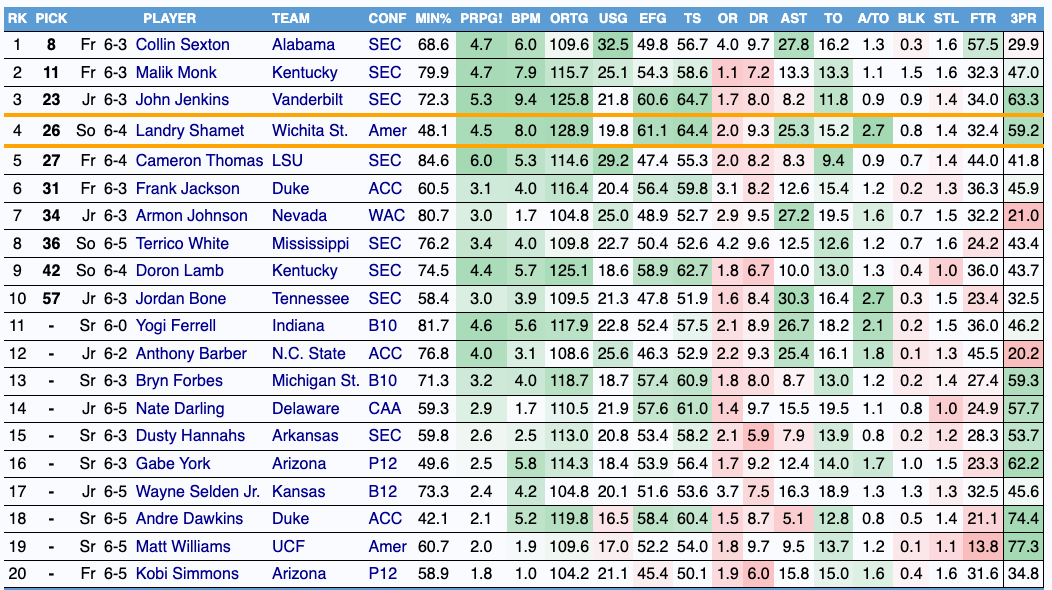
Notably, Acuff’s assist rate sets him apart from many of these players, but it’s this combination of low steals and defensive rebounds that implies a difficult translation, in spite of his collegiate productivity.
If Acuff managed to make more free throws (85% in AAU but 75% in college so far), that would be meaningful for his shooting outlook. Still, the biggest hole is a lack of ancillary impact, which strongly limits his defensive impact and increases the offensive threshold to redeem high level impact. As one of the best guards in the nation as just a freshman, Acuff’s precocious productivity may be a sign that he can hit that immense offensive threshold, but the downside is equally important to consider. It’s why he sits here, below some of his contemporaries.
21. Tamin Lipsey
Lipsey has been one of the most underrated guards in the country since his AAU days. He averaged 2 steals a game with a 2.72 A:TO, which is one of the best combinations I’ve ever seen. Only a handful of 17U AAU players come close, including Tyler Tanner (2.69 A:TO + 1.4 steals).
While he’s been highly productive every year of his collegiate career, Lipsey has hit a new gear. He’s put up a preposterous 5.6 A:TO in 5 games against top 120 competition. While his scoring has always been his biggest hole, there are just not many players who can avoid turnovers on offense and force turnovers on defense. It’s hard to pick up the value of a 5.6 A:TO by watching highlights, but avoiding disastrous outcomes is far more important than creating memorable ones.
The case for Lipsey is fairly similar to that of his teammate, Josh Jefferson. Lipsey is a worse mold, but he has been just as productive. Career 8 BPM across 100+ games is somewhat rare, and doing it with his combination of cognition (2.6 A:TO + 4.4% steal) and physicality (4.8% OREB, 66% ATR) is pretty ridiculous.


Lipsey has pretty clear avenues to high impact with his immense cognition and physicality. He does not shoot particularly well, but career 73% from the line is redeemable enough. Like his teammate Josh Jefferson, Lipsey is likely a clear NBA player hiding in plain sight.
22. Malachi Moreno
It’s been a tale of two halves for Moreno, as he’s ramped his production up recently.

In 7 games against top 120 teams, Moreno has demonstrated incredible skill. 1.1 A:TO and 2.7% steal with 81% FT is just unheard of for a 7 footer, and he’s doing it with elite scoring efficiency. His rebounding has tailed off, but finishing like this is extremely impressive considering that his priors are below the Mendoza line of 70%.
Moreno has curiously finished worse against bottom 240 teams, which is why he’s currently shooting just 68.8% at the rim for the season. Without massive length (he is reported +2 WS), Moreno likely needs to compensate with above-average finishing. Strong feel and rebounding can lower the threshold at which he needs to finish, so getting above the 70% line would be huge for his prospects. I will be keeping a close eye on whether this upwards trend in his finishing persists though conference play. It would yield a more generous final ranking.
23. Jalen Washington
Washington is such an underrated player, as I have not seen him mentioned in a single group chat, let alone on a draft board. The lack of hype is peculiar, as he checks every box for an NBA big: he finishes, makes free throws, and blocks/rebounds. With a 7’4 WS and 245 pound frame at 6’10, this is a pretty obvious impact player.

Not only has he made a whopping 76% of his rim attempts and 47% of his long 2s, but Washington is a bona fide rebounder, he dunks around 45% of his rim attempts, and he takes threes. 17.5 3PR, 69% career FT and 47% on long 2s indicates very strong shooting upside. A stretch big with this kind of physicality would be ridiculously valuable.
Career 6.1% block and 1.1% steal rates are not great, as is the fact that he’s only played 26% of his team minutes across 4 years, but Washington checks pretty much every box.

This year, Washington is at 11.2 BPM vs top 120 teams, with 71% TS and 1.4 A:TO/1.9% steal. And he’s making 78% of his FTs.
Jalen Washington hardly has any weakness, and he’s a pretty easy bet to see NBA rotation minutes from day 1.
24. Morez Johnson
Morez is one of the most impactful players in the country.
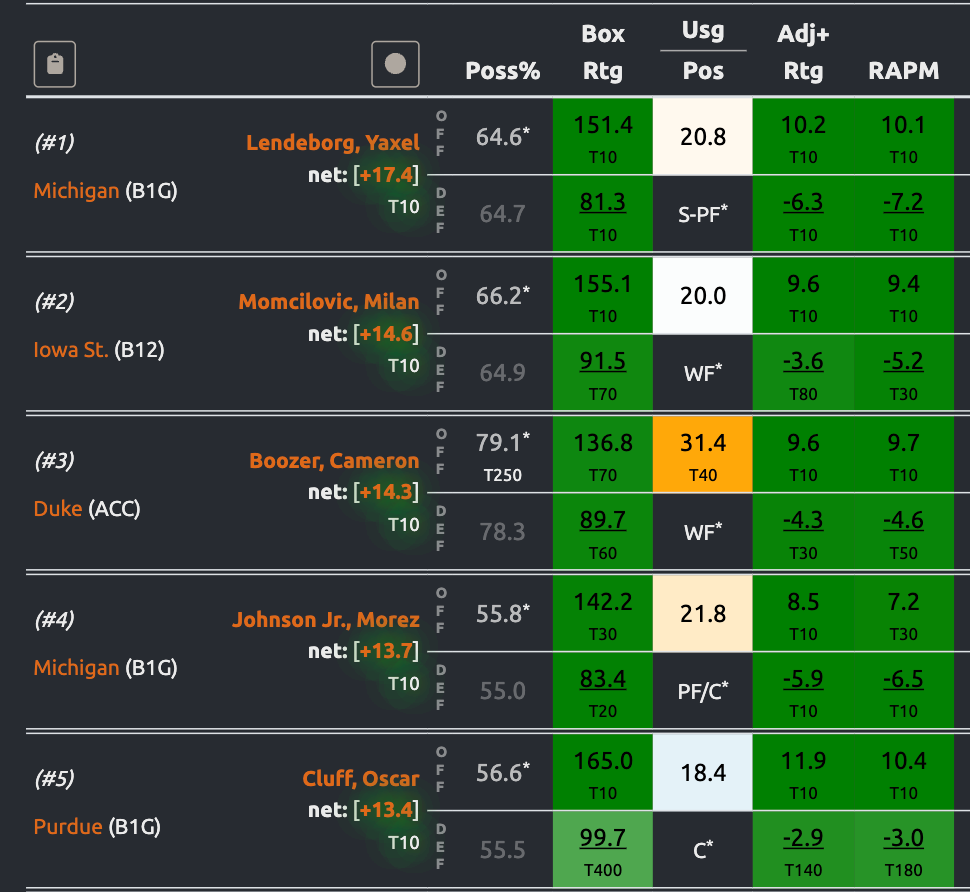
This alone is probably worthy of a first round grade.
Morez has made a FT and passing leap, and continued progress would rank him higher. If Morez measures somewhere around 6’9 with a 7’2 WS, it is necessary for him to increase skill and cognition such that he can play as a forward. With an immense track record of production in AAU and FIBA, along with a 260 pound frame and high level applied physicality, I am far more interested with Morez than with other undersized bigs (ie Flory Bidunga).
25. Aday Mara
This may be too low for Aday, as it is rare to find 7’3 humans with good passing and rebounding on this planet. Aday has even made a finishing leap, as he’s now above 70% at the rim for his career.
And yet, Aday has not been particularly productive despite being in arguably the best possible construct for bigs. Dusty May got Danny Wolf drafted last year, and his multi-big configurations have allowed Morez Johnson and Yaxel Lendeborg to become two of the most impactful players in college hoops. Aday has been fine, and he has shown impressive passing flashes, but his turnovers remain a problem, and he still bricks too many free throws.
With strong rebounding, blocks, and finishing at this height, Aday fits such a nice mold. But with his turnovers, missed dunks, and missed FTs, Aday is a pretty poor iteration of this high EV mold.

Draftable juniors do not ever put up 103.7 OTRG versus top 120 opponents, especially not when they are on the best team in the nation. Improvements in avoiding turnovers and making dunks/FTs are much more feasible than others, but this is year 3 of this experience. If improvements are made, he will be ranked much higher.
26. Nolan Winter
Winter is 7’0 with strong finishing, rebounding, and shooting. He is productive against high end competition, and he is very young for class.

For his career, Winter is converting a ridiculous 79% of his rim attempts while also making 76% of his FTs. And he’s can pass pretty well too, with a career 1.3 A:TO. His defense is a fair concern, but what else is?
Winter is 7 feet tall with some of the best finishing numbers we’ve ever seen. That alone would have him in draftable range, but making tons of FTs while avoiding turnovers is a pretty easy strategy to get drafted.
He’s not a Q4 merchant either.

Winter is at a preposterous 5.5 PRPG/9.8 BPM in 7 games against top 120 teams. He’s making 77% of his 2s, and he also rebounds well (24% dreb) while converting tons of assists per turnover (1.7 A:TO). His stocks aren’t horrible, and he’s drawing fouls at an especially high rate considering his 30 3Pr.
And Winter is born in November 2005, which makes him sophomore aged despite being listed as a junior. Winter has strong anthro, elite production, and an outlier distribution of stats. It gives him pretty unique upside, and it’s why he should be on way more boards.
27. Alvaro Folgueiras
Alvaro has struggled to make his mark offensively in high level competition, as he’s just 0.2 PRPG and -1.5 O-BPM vs top 120 teams. Most of this can be traced back to a horrible 31% TO rate and 50% TS.

While growing pains were to be expected from a player transitioning from the Horizon League to the Big 10, this has been truly bad. I expect better days ahead, because he’s showcased production in important simulacrums, and because strong cognition at this size will find a way to produce.
At least Alvaro has been shooting, with a 50 3Pr and 47% 3P mark on the season. While the majority of his makes are assisted, it is rare for a player listed 6’10 230 to be making 3s at this rate. Altogether, his passing, steals, and shooting acumen, are outlier for his dimensions. If his rumored wingspan of 7’6 is indeed true, then the threshold of production that he needs to hit isn’t too high. And yet, he hasn’t hit that threshold yet. It is important to monitor whether he can.
28. Zvonimir Ivisic
Surprise. Another big.
Ivisic fits a pretty nice mold as a 7’2, 250 pound center that can block shots, make a high rate of rim attempts, and take tons of 3s.
Pretty much no one has come close to this integration. Rare skillset with strong production (career 8 BPM) is usually a recipe for success.
While Big Z taking on the “Kornet role” is possible, I have not ranked him higher due to his very poor cognition indicators. His career marks of 7.1% assist and 0.6 A:TO are decent, but his top 120 numbers have been pretty poor this year.

1.5 assist rate, 0.2 A:TO, and 0.4 steal rate is pretty horrifying, and they cancel out a lot of the unique goodness of this profile. 14% block with just 3 fouls per 40 is pretty outlier, as is his 60 3Pr.
Improved cognition and favorable combine measurements would enable me to rank Big Z much higher.
29. Bruce Thornton
Recently surpassing 5 PRPG for his career, Thornton has been one of the most productive player in college basketball for 3 years. His 3.1 A:TO and 60% TS for career are pretty outlier. This is a player with elite passing, elite rim%, and some of the best shooting touch in the draft.

The reason he isn’t ranked higher is a very suboptimal diet. While the majority of his long 2s are runners, Thornton has taken 2.3x as many long 2s as he has rim attempts. Potentially more concerning is his low 3Pr, as he has just a 38 3Pr for his career. 34.5 FTr and 38 3Pr with almost assuredly poor defense is underwhelming.
This is just another one of the strong passing, elite touch, poor rebounding/stock guards of this class. It’s not a great mold, but Thornton has been so outlier good at the rim and in midrange that adapting his shot diet gives him a ceiling as one of the best scorers in the league. Adjusting shot tendencies is not something one should bet on, but Thornton is playing in a pretty horrible context where many of his teammates are also chucking away in the midrange. At 6’2 215, he does have the frame to continue making a high rate of his rim attempts.
30. Pryce Sandfort
Pryce fits a narrow mold of turnover avoidant shooter, but it’s still unclear how good of a shooter he is.
He’s been the best player for an undefeated Nebraska team that just knocked off Michigan State. It’s a team that is ranked higher in the AP Poll (13th) compared to Bart and KenPom (early 20s), but nonetheless a clearly good team.
A clearly good team that likely has one NBA-adjacent player. I’d bet that the player is Sandfort. He has been on fire against top 120 teams, with a whopping 5.8 PRPG and 11.4 BPM.


Pryce has made a ridiculous rate of his rim attempts while completely avoiding turnovers. There are athleticism concerns, as 9.6 FTr and 0.7 block rate aren’t great signals for a 6’7 210 pound player. Moreover, Pryce was born in June 2004, which is roughly two years older than other sophomores.
This sort of passing and inside-arc efficiency is pretty notable for an elite shooting prospect. Pryce rarely creates (just 4% drive frequency), but he’s able to make the most of cuts and handoffs. In fact, Pryce is in the 90th percentile+ in scores coming out of screens and handoffs alike.
Career 69% FT (just 74 FTA) isn’t too in line with great shooters, but 39% on 300 3PA and 45% on 65 long 2s definitely is. Sandfort has been one of the most efficient players in the nation against top competition, and I’ll be monitoring if he can keep it up all year.
Holy cow. Great, well written board. I can tell you put a lot of effort into this.
Like you, I am much higher on consensus on Tyler Tanner, Patrick Ngongba II, Yaxel Lendeborg, Joshua Jefferson, Dailyn Swain, Daniel Jacobsen, Motiejus Krivas, Tamin Lipsey, Malachi Moreno, Jalen Washington, Nolan Winter, Alvaro Folgueiras, and Bruce Thornton.
You are also lower than consensus on Mikel Brown Jr, Labaron Philon, and Koa Peat, which I agree with
honestly I struggle with how high you are on with Morez Johnson Jr.(undersized big who can't shoot) and Zvoinimir Ivisic(will get bodied in the NBA), but I do see that both are doing well.
Haven't looked at Pryce yet, but I'm intrigued in him.
I could go on for hours talking about all the players you like, so if you wanna talk ball I'll respond.
As a Duke fan, I love Pat. I do have a couple concerns I'd like to hear your thoughts on, though.
I do worry about his defensive upside in the NBA. I understand that his defensive stats are great (e.g., T20 DRAPM, -12.5% ON/OFF opponent Rim FG% delta), but as someone who watches each game, I worry about his physical traits translating.
1. He lacks vertical pop, which makes me wonder whether his elite rim protection will translate up.
2. He lacks the lateral quickness to survive in any ball screen coverage besides drop. Duke loves to switch as much as possible, but it is clear he cannot be involved in that coverage.
My other concern is really just his overall right-now preparedness for the next level. I can't actually quantify this, but I do watch every Duke game, and there are some nights where Pat just isn't engaged/doesn't have it. He lacks consistent assertiveness, which cause him to seemingly disappear in some contests (you can see this in his game logs). This is a somewhat heuristic mindset, but it feels risky to use a lottery pick in a loaded class on a guy who fades as frequently as Pat.
Anyways, great stuff!