Pessimism, ft. Darryn Peterson
A devil's advocate series on the top three prospects

Billed as a generational guard prospect, Darryn Peterson seemed to live up to expectation. After all, he had the highest box-plus minus of any freshman guard since 2008. He led his team to the 4th seed and the precipice of the Sweet 16. Archetypically, he seems perfect: a unique blend of defensive playmaking while sustaining offensive load and shot-making at a virtuoso level.
Clearly, Darryn projects as an high-impact NBA guard with huge upside.
While many of these points are salient, this final sentence is most tenuous. Is Darryn actually high-impact? Is he even a guard?
Defining a guard
Let’s say we had to be reductive, and we had to isolate guards with just basic box score stats.
The obvious, most defining traits of a guard include their skill and cognition. Statistically, that shows up in assist rate and self creation on offense, and steal rate on defense.
Assist rate may be questionable. How about combo guards, or guards known to trend strongly score-first? Well, once you accrue enough usage, everyone’s assist rate looks reasonable. Beal and Kobe are the first names I think of, and they both had strong career assist rates (just not amazing compared to their usage).
While comparing NBA to NCAA is also sketchy, it’s hard to deny that Darryn’s passing simply was not consistent with a guard. He posted just a 12.5% assist rate on monstrous usage, and it was even lower in the final stretch of games to end the season.
It’s difficult to find any positive analogs for this low assist rate amongst guard-sized players. There are some excuses for his assist badness: Kansas was poorly spaced, and he wasn’t blessed with obvious safety valves upon facing help. But this sort of assist (12%) to usage rate (30%) for a 6’5 player is historically bad, to the point that it cannot be excused simply by virtue of a limiting offensive ecosystem. Assist to usage has been remarkably consistent in identifying underrated players and busts across the years.
Much of his poor assist to usage rate has to do with his quick-trigger shooting, and it demands some degree of grace. Darryn has a difficult diet of self-creation, taking early looks regardless of coverage intensity. Adding off-the-dribble threes to your decision-tree limits the passes you can make, and this tradeoff is important in projecting playmaking improvement. Darryn’s assist rate probably isn’t as historically dire as the raw assist:usage would indicate. One great example of this tradeoff would be Bennett Stirtz, whose 3P volume rose and assist volume dropped this year.
Another would be Jamal Murray, who I’ve seen as a consistent optimistic comparison for Darryn’s low passing volume. Jamal also had a 12% assist rate in college, and now he’s pushing high 20s assist rates.
We do have to note that this sort of development is not especially common. You have to comb through dozens of AST:USG busts to find the few success stories that went from low assist rate to high assist rate in the NBA.


But it’s also notable that, in a head to head, Jamal was more efficient as a rim scorer and 3P shooter.
Did he play a more off-ball role with better safety valves and easier looks than Darryn? Absolutely.
This can be construed as a positive; Darryn’s ability to re-organize midair and take tough shots is itself outlier, and he is a clearly efficient pull-up shooter.
But without taking more stable shots, Darryn’s offensive output may be more prone to variance; so much of his offensive impact is based on making shots. As seen in this comparison, Murray wasn’t as midrange reliant as Darryn, and he was a much better finisher (he is now a mediocre finisher in the league).
Does shot diet actually matter?
While Darryn was objectively efficient, his 57.8% TS on the season is closer to great than elite. His eFG and TS% lag behind Murray, even though he was way better at making midrangers and FTs.
Much of this has to do with taking twice as many midrange attempts as rim attempts. This is one of the most fundamental bust indicators, as demonstrated by this query with players of less than 100 rim attempts and more than 120 long 2s. An important caveat is that most of these players did not get up threes at Darryn’s volume, but a two-point diet so slanted in favor of the midrange necessitates elite midrange shooting to even break even as a 2P scorer.
And even when Darryn got to the rim, the results were questionable at best. His 59% rim percentage is barely average for position, and below average for NBA drafted 2 guards. It slipped to 52% at the rim in the half court.


And to end the season, purportedly in the games that he was healthiest in, Darryn shot a terrifying 42% on 2s and 49% at the rim. Note how just 33 of his 109 2P attempts were at the rim, the lowest rim rate of the four. Even less so than Ament.
Were there residual effects of injury? Hopefully less so across these final 13 games, but I suppose that it’s a reasonable consideration.
The issue is that this HC rim badness isn’t a particularly new issue.
In 15 3SSB games, Darryn shot 16/34 (53%) on halfcourt rim attempts, and 42% on halfcourt 2s. This is basically identical to what he did at Kansas.
There are a few cases where mediocre rim% is overcome, usually because the prospect gets to the rim a lot. Think Trae Young or Shai. There are also cases where a low rim rate is overcome by virtue of strong finishing. But to take so many more long range attempts than rim attempts and finish poorly is a difficult sell.
Think about the sum of the parts. Darryn is a below-average playmaker, doesn’t generate enough paint touches, and doesn’t finish well. How many of the comps being floated for Darryn even remotely consider these? I struggle to see the “initiator” upside without massive improvement in two of these facets.
Discerning Impact
High usage without strong efficiency or passing is one of the surest ways to leak offensive impact.
And this is what we saw. Darryn’s team-wide offensive impact was especially weak. Kansas was +4.5 points better on offense with Darryn off. The team was especially poor with Darryn and without Council’s steadying hand.
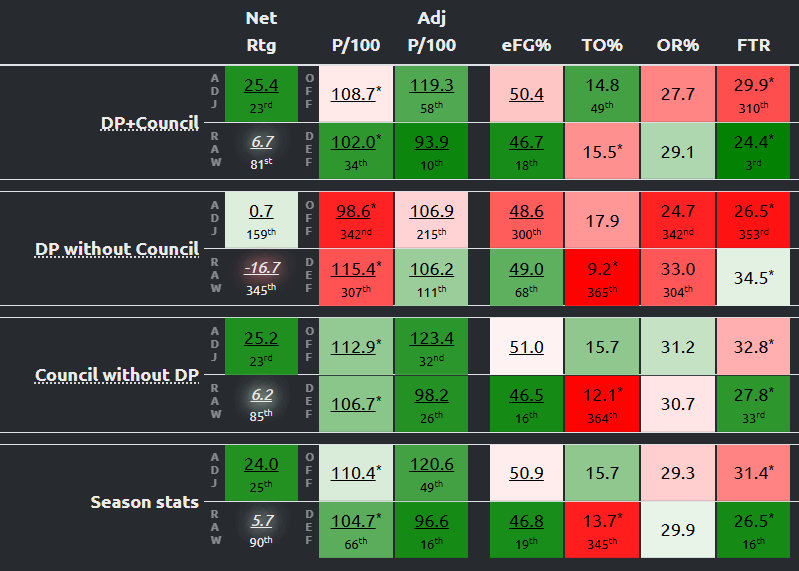
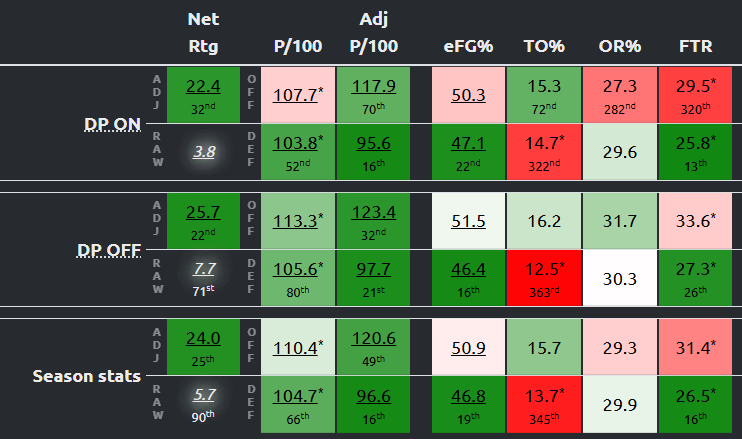
While on/off numbers are sometimes viewed as unreliable, much of my consternation has to do with a limited “off” sample and defensive noise. For example, Dylan Harper had a neutral on/off rating at Rutgers, but it was strongly weighed down by a largely negative defensive swing, and the sample of minutes with him off the court was nearly three times smaller than the “on” sample.
We cannot make the same considerations for Darryn; he missed enough games to where the “off” sample is just as strong as the “on” sample, and we’re specifically focusing on the offensive end.
Unlike Boozer and Dybantsa, DP’s lack of clear offensive impact is a glaring flag. There are contextual considerations, but it’s a concerning tier of impact.
Summary
This is the fundamental issue with projecting Darryn as a high usage primary. While he does take tough shots and makes them at an above average rate, his enormous usage makes him disproportionately responsible for the team’s offensive outcomes. When he’s at monstrous usage, takes more than twice as many midrange attempts as rim attempts (one of the more fundamental prospect red flags), and passes at a historically low rate, his team’s offensive floor is low. Even pure 2s like Kobe and Beal were well above a 20% assist rate from 2000 onward; in the last 2 months of the season, where Darryn appeared healthier, he had just a 10% assist rate on 52.7% TS.
Implied by his draft slot, there will be a necessary exchange of quick-trigger shot-making for meaningful passing growth.
A Refutation
It is admittedly difficult to handwave both low passing and low rim scoring. Pretty much every successful guard is reasonably good at both, or at least dominant at one.
But the closest match may actually be Keyonte George. Keyonte passed at a higher assist to usage rate, but Darryn was undeniably better at pretty much everything else. To match, if not exceed, Keyonte’s offensive production while strongly outproducing him on defense would be a clear impact player. Keyonte is one of the more heavily assisted players in the league, and Darryn would have to be okay pushing transition and scoring off cuts the way Keyonte is.
The defensive floor is so strong that DP’s ceiling is still tantalizing, should he arrive in an ecosystem where he’s not expected to rack up monstrous usage from day 1. Elite shooting and defense with strong combine testing and anthropometrics is indicative of long-term staying power. He probably scales down the cleanest of these 3.
Moreover, DP did test well at the combine. Comps like CJ McCollum or Devin Booker may seem like low-balling, especially with their low impact metrics. But the reason they aren’t rated as highly is because they are some of the worst defensive players in the league. Even Klay was consistently bottom of the league in deflection rate. Something like Darryn matching CJ McCollum offense while being +3 better on defense is far better than any comparison mentioned. And it seems fairly feasible.