Pessimism, ft. Cam Boozer
A devil's advocate series on the top three prospects

There isn’t a metric that Boozer didn’t crush this year. He led the nation in PRPG, BPM, RAPM, BPR, and he leads every single draft model I’ve seen. For example:
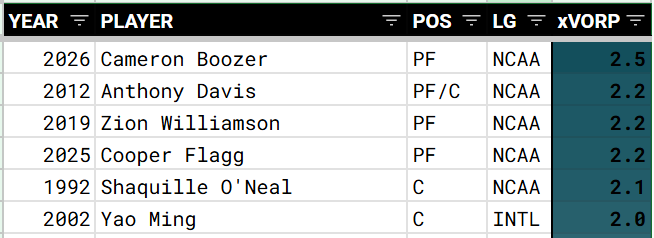
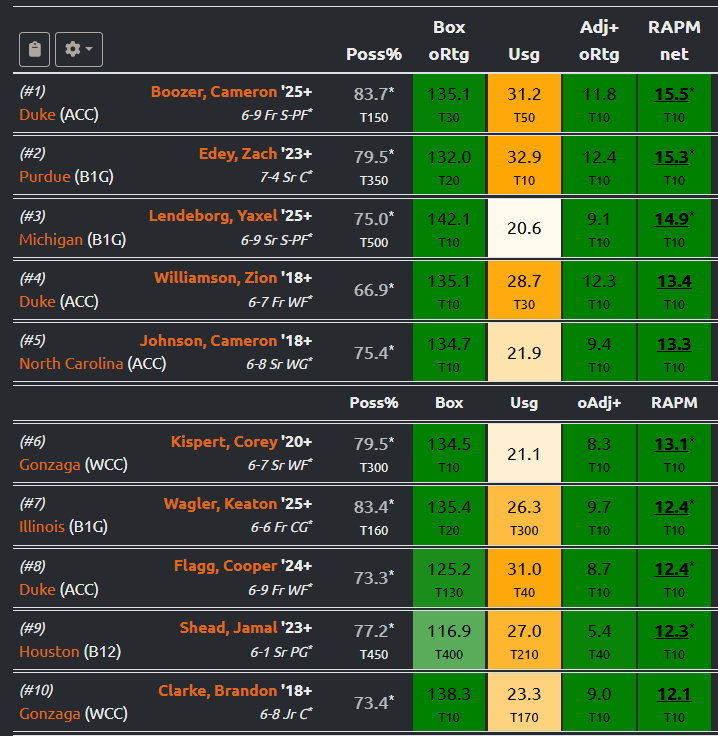
Strong rebounding and passing is probably the single highest signal intersection. Boozer paired it with elite scoring efficiency. It’s too cracked. Did I mention that he had clear defensive influence on a top 5 defense in college basketball?
Why not end the article here?
Well, it’s not immediately obvious within the profile of a player who shot 62% on 2s and 39% from 3, but Cam’s biggest weakness may be his scoring upside.
This is far more obvious on watch than from stats. Boozer’s post-up oriented scoring style, with his reliance on footwork on fakes, has caused many CBB watchers to compare him to NBA busts like Hansbrough (see: the Club 520 podcast) and Okafor.
It reminds me of the discourse around Zach Edey. In fact, I directly refuted these comparisons in my defense of Edey:
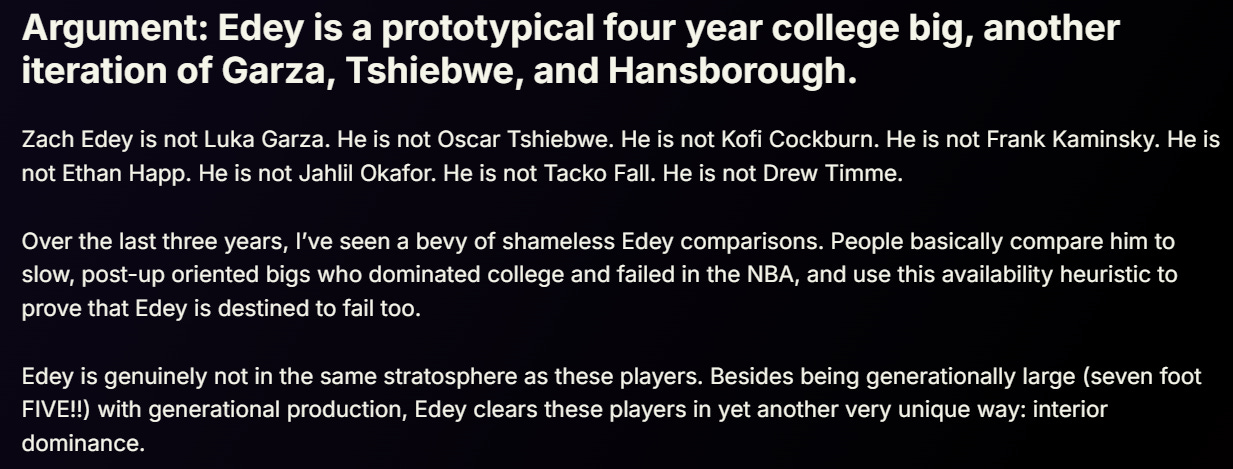
Well, this worked for Edey because he was generationally large with elite interior dominance. Boozer is not 7’5 nor does he exhibit even close to the interior dominance of Edey, giving this criticism some credence.
Boozer does crush these players by cognition and skill; Hansbrough, Tshiebwe, Garza, etc. were not even close to the level of passer and shooter that Boozer is. But how about as a scorer? Is there any sort of interior dominance?
Estimating Boozer’s Interior Dominance
The first, and most obvious limiter: Boozer’s height and athleticism are at a crossroads. He’s 6’9 with a sprint and standing vertical that would be more in line with centers rather than forwards. This can also be said about the distribution of his scoring profile.
He showed a bit more juice in AAU, but at Duke, Boozer simply lacked any sort of rim-scoring counters. The decision-tree inside the arc once he committed to scoring was pretty straightforward: get near the rim, get some fakes up, and/or go up for the shot. He ranked in the 1st percentile of runner frequency and 2nd percentile of hook frequency. In this way, Boozer demonstrated an utter lack of a midrange shot. He shot just 1/10 on dribble-jumper 2s across the season. To not take runners, hooks, or dribble-jumpers is highly un-forward-like, as heavy rim-reliance is typically a trait of centers.
That’s maybe fine if you’re gonna instead take lots of rim attempts and convert them efficiently. But for a player with such a heavy rim rate, Boozer’s rim scoring is actually the main red flag.
His rim percentage is a pedestrian 64.5%, despite being assisted on 43% of his rim looks. This is a concerning combination, because it indicates that Boozer neither scores efficiently enough nor self-creates enough as a rim scorer. Find any list of the top players in the NBA: how many of those players had a high assisted rate and low rim conversion rate in college or the NBA?
If the intuition isn’t clear, it’s that the more assisted your shot diet is, the more efficient you should be at the rim. Guards, on average, have much lower rim FG% than centers, because they create more rim attempts that are unassisted.


Boozer’s 64.5% Rim FG% and 43% Rim Assisted% lines up with the positional average of wing forwards and stretch fours.
Moreover, Boozer’s rim inefficiency and lack of verticality converged with a concerning “blocked rate”: 8% of his rim attempts were blocked, which ranked in the 33rd percentile nationally.
To regroup:
Boozer has an undeveloped non-rim counter, ranking < 2nd percentile in frequency of each type of non-rim two-pointer.
But amongst his rim attempts, he converts them at an average rate for a wing forwards.
Being extremely rim-reliant while not actually standout at rim-scoring presents a clear NBA translation problem, especially as his skill edge decreases and athleticism deficit increases.
An especially problematic stretch
This is a translation problem that even casual CBB fans are familiar with, as Boozer’s worst stretch of the season was his most watched, in the postseason. In these uber-high leverage minutes, he positionally played more of the 5 with Pat Ngongba out. But his play-type distribution shifted, more consistent with a guard/initiator.
From March 12th onwards, Boozer shot a concerning 52% at the rim, and a whopping 15% of his shots were blocked, which ranked in the 4th percentile nationally. To do this at 6’9 with a reasonable diet of assisted rim attempts is borderline catastrophic. The games against Virginia and UConn were especially telling, as he was blocked a staggering 12 times. In these games, Boozer’s “cognition” indicators were also concerning: he averaged 4 turnovers per game (2nd percentile) with a 1.1% steal rate.
I’ve clipped Boozer’s six blocked shots in the final game versus UConn. Notice anything?
Many of these blocks did come as a quasi-creator, particularly on drives out of PnR and isolation. But the central issue is his fake-heavy, groundbound creation, which increases the contestability of his attempts and makes him prone to being completely cut off on drives. The lack of counters are so painfully obvious: adding a scoop or floater would go a long way in giving him higher EV looks.
Is that even possible though? How easy is it for someone to add a midrange game? He has really good touch, but it’s hard to find a comforting analog.
Boozer’s Role
Back to the issue of translation. It is virtually impossible to expect Boozer to continue taking such a heavily rim-skewed shot diet with his relative rim scoring mediocrity and lack of center height. To reach his “upside”, he will need to find a more creation-oriented role. He can get to the rim, and he can shoot decently, but as I’ve alluded to: the lack of midrange counter coupled with his multi-fake, heavy stance rim-creation style makes it difficult to completely trust his 2P translation.
So even with his elite AAU and NCAA 2P%, Cam’s scoring profile isn’t especially reliable at any of the 3 levels, with questionable rim scoring, limited midrange counter, and average 3P volume with slow release.
Then there’s his defense. He doesn’t eye-test as a great defender, though his on/off’s are pretty strong. With average stocks, the answer is probably somewhere in the middle.
There were many times where Scheyer hid Boozer in the corner, probably concerned that he would be burned when defending in space. His isolation defense numbers were fine: he was ranked amongst the 87th percentile in defending isolation while guarding them at a 76th percentile rate; this mostly came from forcing a shit ton of turnovers (20% TO rate). It’s fair to wonder how effective he can be as an on-ball defender, and this is even more pertinent depending how far on the positionality spectrum he transitions.
But his post defense is arguably more concerning: he ranked in the 26th percentile in defending postups despite guarding postups at a 60th percentile rate. Some of it is a low foul rate, but he needs to become much better at contesting first chance points instead of relying on eliminating second chance points.
With both post-oriented offense and defense presenting challenges to Boozer, it appears as if he should be “wingified” and eventually play more of the 3, with a more “wing creator” shot diet. Something like Scottie Barnes or Jalen Johnson, except with meaningful 3P shotmaking.
But his scoring probably needs to develop in a major way for that to really work. It’s a theory that we’ve never seen in practice, making it somewhat risky bet. For the other two players, we’ve basically seen what they’d look like in a “fulfilled upside”, but it’s not immediately clear what an optimized Cam would look like.
Perhaps that’s just evaluator uncertainty rather than a legitimately wide range of outcomes. But it’s an important consideration, because his team needs to share that vision instead of using him the way he’s been used for his entire life (as a true big).
Despite all-time production, Boozer’s scoring and defense could limit his upside.
A Refutation
Even with the concerns stated, Boozer is my top prospect this year. While his 2P scoring is flawed, he still averaged 22.5 points per game on sparkling efficiency, plus he projects to be one of the best 250 pound shooters in the league from day 1. There isn’t any fundamental red flag with Boozer, more a series of scoring concerns. His track record of production and huge two-way on/off impact bolster his floor. He’s so young and precociously talented that making the suggested improvements seems more likely.
Another great article, some really valid points here. A couple things I'd raise:
- I am not that familiar with his AAU/HS priors, but it could certainly be argued that the absence of a midrange shot diet was an artefact of the Scheyer scheme/offense. Are we sure he doesn't have more counters that simply didn't come out?
- I think the usage can partially explain the rim efficiency regression in March and the lack of post defense
- I like that you referenced the impact of Ngongba's absence. The on-off splits are really staggering and I don't think he can viably play up/big at the next level.