Part 2: Plausible (but still deep) Draft Sleepers from LNB Espoirs
More fascinating players from France's U21 league in 2024

By all accounts, Espoirs typically isn’t a reservoir of NBA talent. It’s the premier U21 league in France, but dominating it is not the surest sign of future stardom.
For instance, the most productive teen in Espoirs in the last ~ decade was Killian Hayes. He was extremely young (16) and utterly dominated in every single possible aspect. And we know how he fared in the NBA.
But as of late, there have been so many drafted Espoirs alumni.

Based on my database, there have been 9 Espoirs alumni from the last 8 years that have been drafted to the NBA. Off the bat, there’s a pretty simple heuristic for finding any relevant prospects that play in this mickey mouse league: youth. All 9 of these alumni logged at least one season under the age of 18.0 in this league. It doesn’t sound like much, but in a U21 league, there’s only a handful of 17 year olds playing meaningful minutes each year.
Out of the Espoirs players this year, I’ve tried to pinpoint players that have some inkling of chance being truly productive players at some stage in their career. This is especially fun because there is absolutely no full games/Synergy out there on Espoirs players, other than the occasional cherrypicked highlight video. I’ve embedded a few of these highlight videos, but this is really a useful exercise to see how much I can ascertain goodness and project upside solely off RealGM box score stats.
I’ve split this into two parts, both of which contain sleepers from Espoirs. I do not think anyone appears likely to be drafted at the moment, but this series is divided into plausible sleepers (players with some semblance of pedigree and reasonable tail risk parity) and deep sleepers (hyper-underrated players off the map completely, with real warts but fascinating upside tails).
This is the plausible sleepers review; you can find the deep sleepers iteration here.
At the moment, I would be somewhat surprised if any of these players was drafted; but even with developmental uncertainty baked into their low draft price, there is enough upside to keep an eye on these guys in the coming years.
1. Joan Beringer
Joan is highly productive big by PER with solid FIBA numbers, but outlier low tweener score (shoots no threes, does not pass, and blocks are good but not special). Probably going to dominate Europe in half a decade. He’s really really good, but I’m writing this with NBA prospect interest in mind, which is why he’s lower. But just purely by production, he’s fr the best guy here.

He turns it over a lot for a guy who plays a very specific playfinishing role. And he’s a bit undersized to be a 5 (listed 6’10). But honestly, this is a guy who I should probably rank a bit higher. 65% TS + 24 PER + 17.5 age bodes really really well. He’s also an utterly ridiculous rebounder: 17.6 ORB!!! and 26% DRB, for a total rebound rate of 22.3%. He was ~ 10 rebounds/40 at FIBA U18s, so this is definitely a clear strength regardless of comp.
But the most moving aspect of his profile is his speed + length. According to this video’s caption, he has a 7’3 WS.
To be clear, the bar for this kind of archetype is pretty high (usually some combination of high double digit dunks + elite rebounding and shot blocking) BUT elite length is a useful antidote to parse out NBA talents that don’t meet all of those thresholds. I wrote earlier about the importance of length to indicate NBA-caliber rim protectors, and Beringer has a chance to meet those physical thresholds.
Beringer moves so well. Incredibly well. He’s dunking on guys off lobs, he’s running the full court smoothly: it is really reminiscent of Daniel Gafford or Kel’el Ware. Gafford and Ware both put up 50+ dunk seasons, tested < 3.3 sprint, and > 36 inch max vert. Gafford has a 7’2.25 WS and Ware is at 7’4.5. It’s somewhat impractical to derive that just from a highlight reel, but it does seem like Beringer is in line with those kind of speed/agility testing scores.
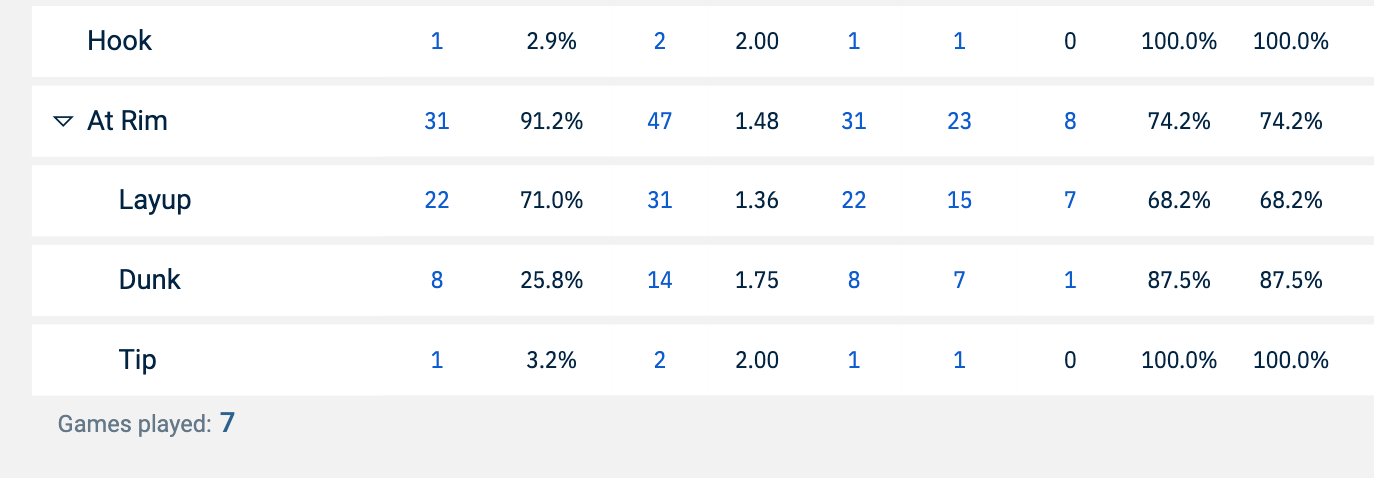
We obviously have no Synergy numbers for Espoirs, but Beringer seems to have a high HC dunk rate. In the halfcourt, 74% rim percentage and 7 dunks in 7 games is pretty great. This is in the FIBA u18 euro championships, so it’s not entirely mickey mouse comp. Known HC dunk demons Kel’el and Gafford were at 1.3 and 1.8 HC dunks/game, but it’s easy to make an argument that age + context + minutes would give Beringer a higher HC dunk rate.
There’s really not too much else. Beringer was the third leading scorer and the highest PPP (1.35) on a 5th place French team in the u18 Euros, but I’ve really never heard this guy’s name. He was at Eurocamp, where he was pretty underwhelming in just 33 minutes, and there isn’t anything regarding his time at Under Armour Elite 24.
One huge red flag: terrible FT shooting. Across Espoirs+FIBA, he is 33/74 (45% FT) from the line. He also doesn’t get to the rim as much as I hoped in a lower level like Espoirs (36 FTr). He’s not going to be a floor spacer on impact.
Also, Beringer needs to continue his productivity next year in improved competition. Legit FT% and block% leaps would be massive. He did struggle with TOs in Espoirs a bit (16.5% TO on 18% USG), but he was also 2 assists/40 to 0.6 turnovers/40 at FIBA. A playmaking leap is not out of the question.
But this guy is pretty young. We’ve seen raw, toolsy underclassmen with unappealing stat profiles and poor touch end up with productive careers. DeAndre Jordan, Javale McGee, even Jarrett Allen. The garbage time big man is perhaps the lowest friction archetype, and the biggest barrier to entry is really just anthropometrics.
If Beringer hits the 7’4 WS threshold on combine day, then this is absolutely a guy for this draft. If the video was capping and he’s actually like 7’1 WS, then we need to regroup. And ofc, this is mainly conjecture off a highlight video and its caption; there’s a great chance he has more typical measurements.
But if Beringer is truly ~ 7’3-7’4 WS + 35 inch max vert + 3.3 sprint, then we really need to have a conversation. This was one of the most productive players at FIBA u18s this year, who also crushed Espoirs at 17.5 years old. An Espoirs’ 25 PER + 23% rebounding + 65% TS at 17.5 is very notable, as is 1.35 PPP + 70% 2P + 20 points/40 in 7 games at a highly useful international simulacrum.
At 17, Beringer’s combination of length, mobility, and sheer production at size gives him very decent outs to hitting as one of the low friction molds a la the aforementioned players. We will see how he tests and how productive he is this year, but I’m surprised there hasn’t been more hype for a guy in a draft environment that sometimes seems to overemphasize defensive versatility for bigs. It’s early, but Beringer is quietly one of my favorite prospects for the 2025 Draft.
2. Louka Letailleur
Height: 6'6" Birthday: May 22, 2008
Team (2024): Espoirs Gravelines-Dunkerque
Team (2025): BCM Gravelines-DunkerqueEspoirs is dominated by guards, as I found it hard to find any teenage wings this year who were even middling contributors. While Letailleur’s production profile does not look particularly interesting, the pitch is really just based on precocious Espoirs production, positive mold, and solid FIBA production.
Based on my calculation, Letailleur was the youngest player in Espoirs this year that actually played real minutes. He was 15 throughout the entire season, and we know that age is the most important indicator of future draft potential for these Espoirs players. He’s on decent trajectory.
Second, he fits a positive mold. He’s a 6’6 shooting forward with strong 3P volume, and what seems to be a decent wingspan and good movement and dribbling skills (based on these nondescript highlights). This low friction mold makes him more likely to be pushed as a useful role player, ie many of the French wings drafted this year.
Finally, he has flashed some decent goodness in FIBA. Just a few weeks ago, Letailleur was named to the U16 Euros All-Tournament team, leading France to the gold in a pretty moving production line. He’s clearly built lightly, with just a 0.22 FTr in Espoirs and 0.2 FTr in FIBA, but he can really rebound: he put up a monster 7.8 oreb in Espoirs, and averaged 12.6 rebounds per 40 in FIBA.
Yes, it remains to be seen how useful FIBA U16s are in projecting long term prospect goodness. But from what I’ve seen, it’s not a datapoint worth throwing away completely. No one is asking you to make broad extrapolations off this tournament, but it is fairly obvious that good prospects tend to play well at major prospecting simulacrums. And Letailleur leading a solid French team to gold prolly means he deserves some consideration as a prospect.
The downside is that he really wasn’t that good in Espoirs by some telling athletic proxies. 11.9 PER doesn’t mean much tbh, but he was at just 6.8 2PA/40, 0.22 FTR, and 1.7 STL%. He wasn’t really passing too much either (just 7.6% assist with 0.48 AST%/USG%). Obviously, some of this is prolly due to role (6.8 2PA: 4.6 3PA implies that he was largely spotting up), and the A:TO was just under 1, but just 1.9 stocks/40 and overall 11.9 PER is still not very encouraging.
Still, this guy was 15 in Espoirs playing ~350 total minutes while fitting a low friction mold and also demonstrating strong FIBA productivity against his age group. It’s an interesting enough profile to bet on. Not much to analyze beyond that given his lackluster profile, but Letailleur may be the best bet here to eventually go high in the (2027) draft.
3. Soren Bracq
This is the first of two long-term dart throws on point guard goodness.
The one Espoirs alumni who I haven’t mentioned much is Ajay Mitchell. I was admittedly far lower on Ajay than consensus, and I still am concerned about his production profile relative to his competition, amongst other things. But this is a useful case study in understanding developmental trajectories.

There’s a pretty good reason Ajay rarely shows up in any Espoirs queries. In his only season, he was an inefficient, low usage guard with poor defensive playmaking. 48% TS + 11.2 PER is pretty horrible, and then you throw in a paltry 1.9 stocks/40 + 17.5 usg for age. Not one block. And none of this is really excusable by age: 17.9 is on the higher side for Espoir’s NBA alumni to begin with.
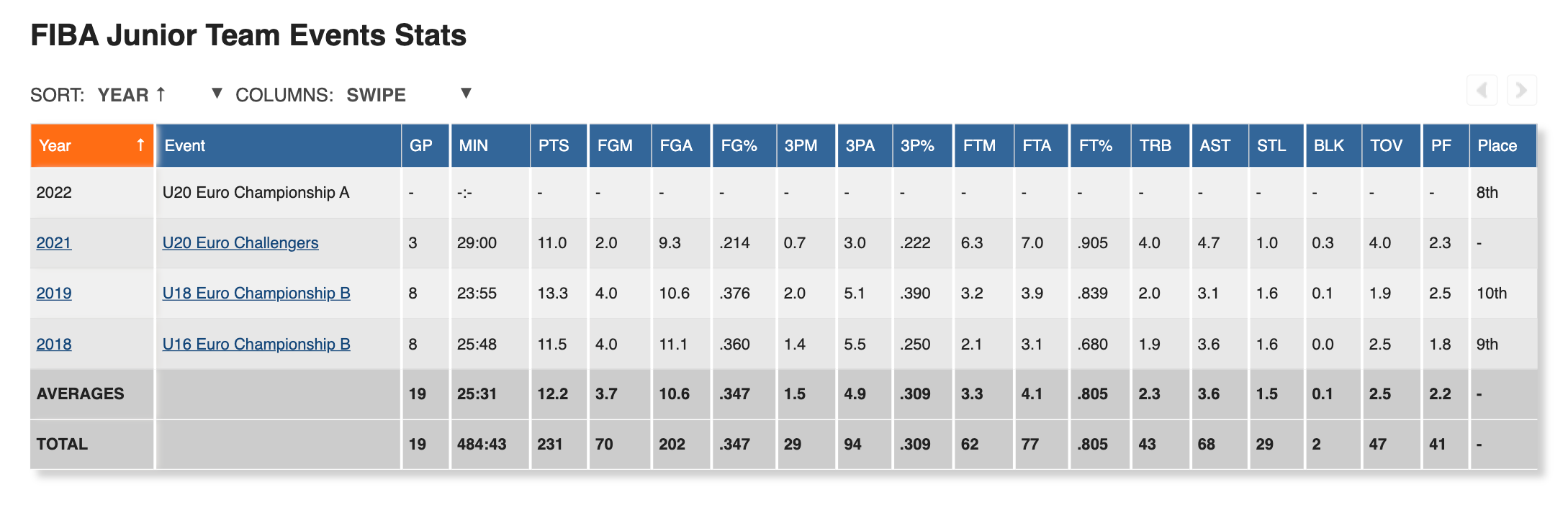
Ajay’s FIBA history is pretty unremarkable, putting up poor counting stats on terrible efficiency on a really bad Belgium team. Belgium wasn’t even playing in the A division, and the B division that they were playing in is considered far, far worse. There’s an insane number of false positives amongst even the best of the best of the B division, at least historically. And in 19 games for Belgium before he headed to UCSB, Ajay was shooting just 35% from the field, for a clearly subpar team (9/10th place finishes in the B division).
To summarize, Ajay put up 48 TS/11.2PER/17.5USG in Espoirs at 18, while shooting ~ 36% in 16 games of FIBA Euros B division comp. This is frankly not a guy that would be on even the absolute sharpest of draftniks’ radar based on his pre-NCAA sample.
But clearly, Ajay was pretty decent at UCSB. Even if the competition wasn’t the most stellar, he was 115 OTRG and 59 TS. He was selected with the 38th pick. What happened? Let’s revisit the profile.
The one place where Ajay decidedly stood out was his passing productivity. He was strongly anti-turnover, with 12% TO and 2.2 A:TO. ~ 1 AST/USG and 1.44 AST/TOV is impressive as well. Throw in the 2.4% STL, and you have a decently sized guard (measured 6’3.25 with 6’6.25 WS and 8’5 SR) who can pass a bit.

Going to his UCSB stats, there really wasn’t too much of a change in these feel stats during his 3 years at UCSB. He was archetypically a turnover avoidant point guard with decent usage. The steals fell a bit, though 0.9% block over 85 games is interesting (via his 8’5 SR, rather than his paltry 28 inch standing vert). Even if Ajay’s profile had some red flags (especially as a shooter) and even if the 59% TS is a bit questionable given the comp (only 3 other BW players drafted this century), its an improvement nonetheless over his 48% TS in a youth league.
But the bigger takeaway is similar to what I’ve been preaching in other articles: strong feel (typically ascertained via A:TO) with decent physicals is a strong recipe for scoring development over expected. As Layne succintly noted in his magnus opus, players with strong vert + A:TO had a higher developmental trajectory over expected
This matters because I can simply find an Espoirs player with outlier good feel and athletic tools and give them some benefit of the doubt. Meet Soren Bracq.
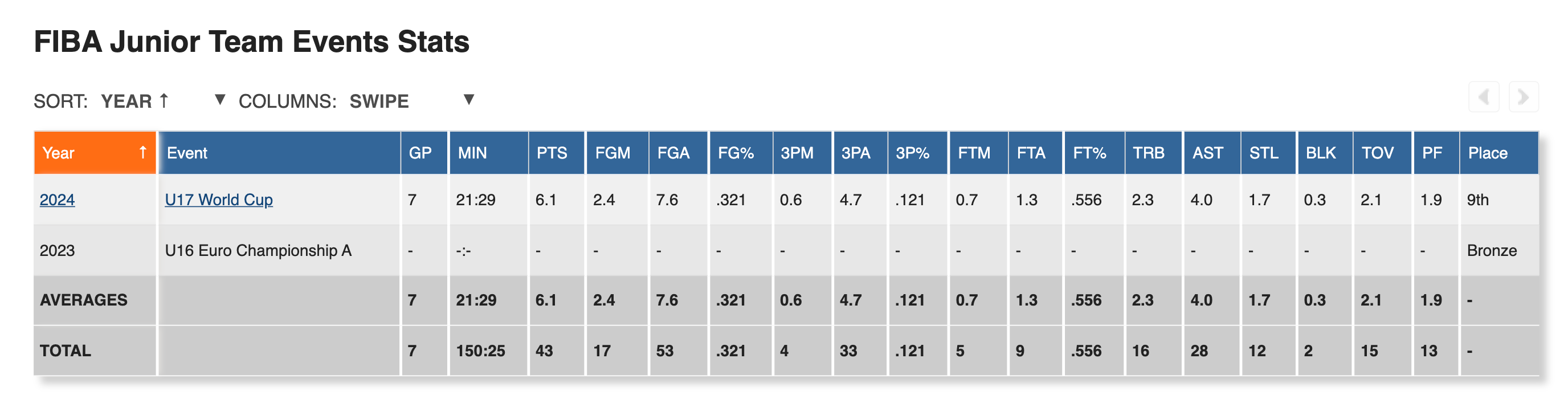
Let’s start with the bad. Soren averaged just 6 ppg/32% FG on a pretty bad France team (sans 16 year old Hugo Yigma) in this year’s U17 WC. Yikes.
But look closer and there’s some real upside. 8 assists to 4.2 TO per 40 is interesting, as is 3.4 steals per 40. Despite 12% 3P, he was at 3.6/5.8 on 2s/40, good for ~60% 2P. A pessimist would point to terrible 3P/FT numbers and worry about shooting upside for a guy listed at 6’4, which is fair.
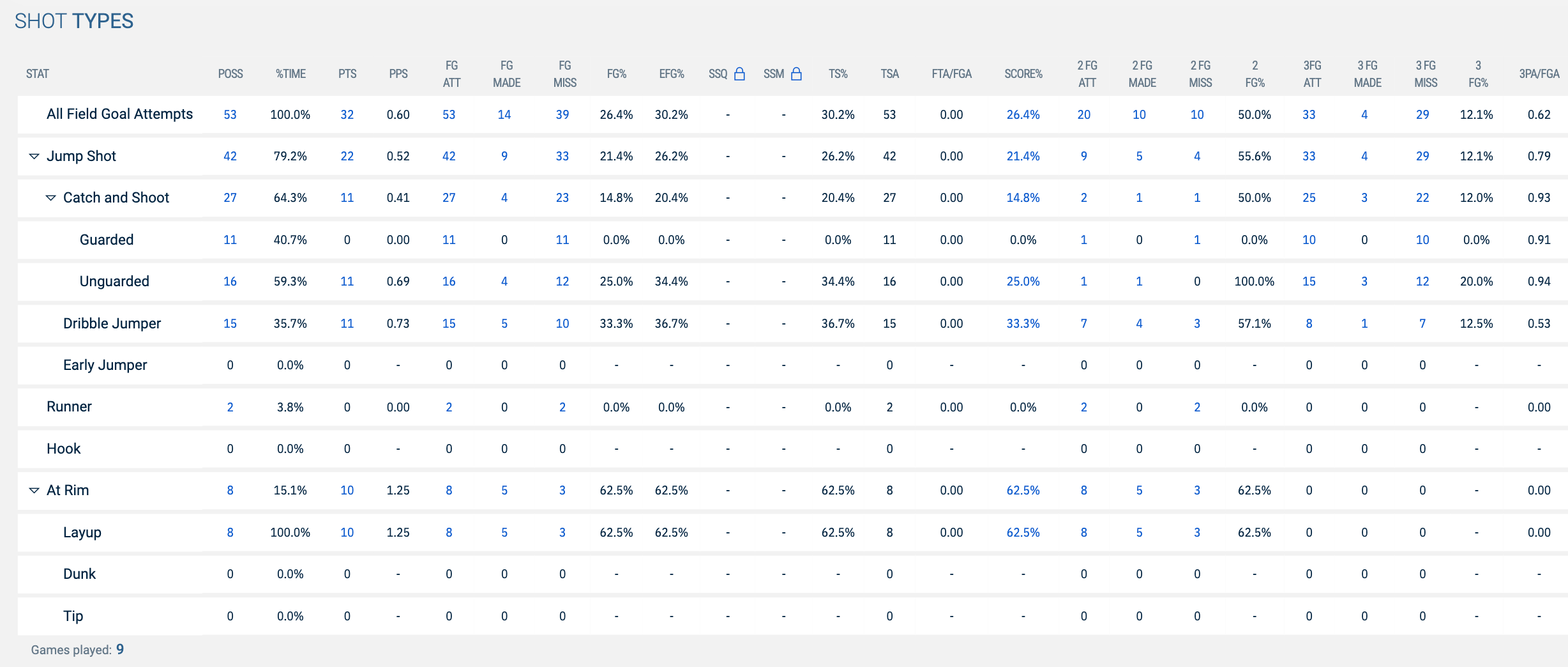
5/8 on HC rim attempts in 9 games with no dunks is eh. 1/8 on HC dribble jumper 3s indicates some level of comfort shooting, and that kind of volume makes me a little optimistic that 3/25 C&S was headed for positive regression. Nonetheless, 3/25 on catch and shoot 3s is really terrible.
Some interesting clips here. Two things stick out: his severe lack of vertical pop (barely got up even in transition) and his comfort commanding the offense. He has a very functional handle: no crazy crossovers or anything, but his handle cadence was consistent and unbothered by swooping defenders. Some interesting driving craft, and he can really rack up steals. Immensely high motor defender. But again, highlight videos are highly variable. They clipped all his 3P makes all in a row, as if he didn’t go 4/33 on 3s for the tourney lol. Cool prospect tho; reminds me a lot of Ajay in his PnR control and poor vert.

Take this h2h comparison between Ajay and Soren, start with passing. Soren is half a year younger than Ajay but was a pretty damn good passer in Espoirs. Cleared Ajay in every stat other than turnovers and assist:turnovers. 26% assist, 21% usg, and 1.6 AST%/TOV%, with 2 A:TO is pretty useful. He also massively cleared Ajay in steal rate (3.5 to 2.4), in PER (20.2 to 11.2), and in TS (61% TS vs 47% TS).
This is a huge deal imo. A guy who was 16 for most of the Espoirs season was putting up 20 PER on 61% TS while being a legit good floor general. This is one of the few young guys that we’ve seen is actually good at leading an offense.

Side note, but it’s really interesting how Ajay was shooting so many 3s in Espoirs when the overwhelming predraft narrative was how he could raise his 3P volume post hoc UCSB (low minutes obviously is the biggest caveat, but still). Went from 5.7 3PA/40 in Espoirs (2020) to career 2.8 3PA/40 at UCSB (2022-24).
The differences in Soren and Ajay’s scoring profiles are even more dramatic. Soren is at 20 ppg/40, while Ajay was at just 13.3 ppg/40. But the biggest reveal is that Soren was a legit elite shooter last season: 45% 3P on 7.2 3PA/40. He did only play 475 minutes (still 220 more than Ajay), so his volume wasn’t as robust as one would hope, totaling just 86 total 3PA. 76.5% FT is pretty good but not worldbeating.
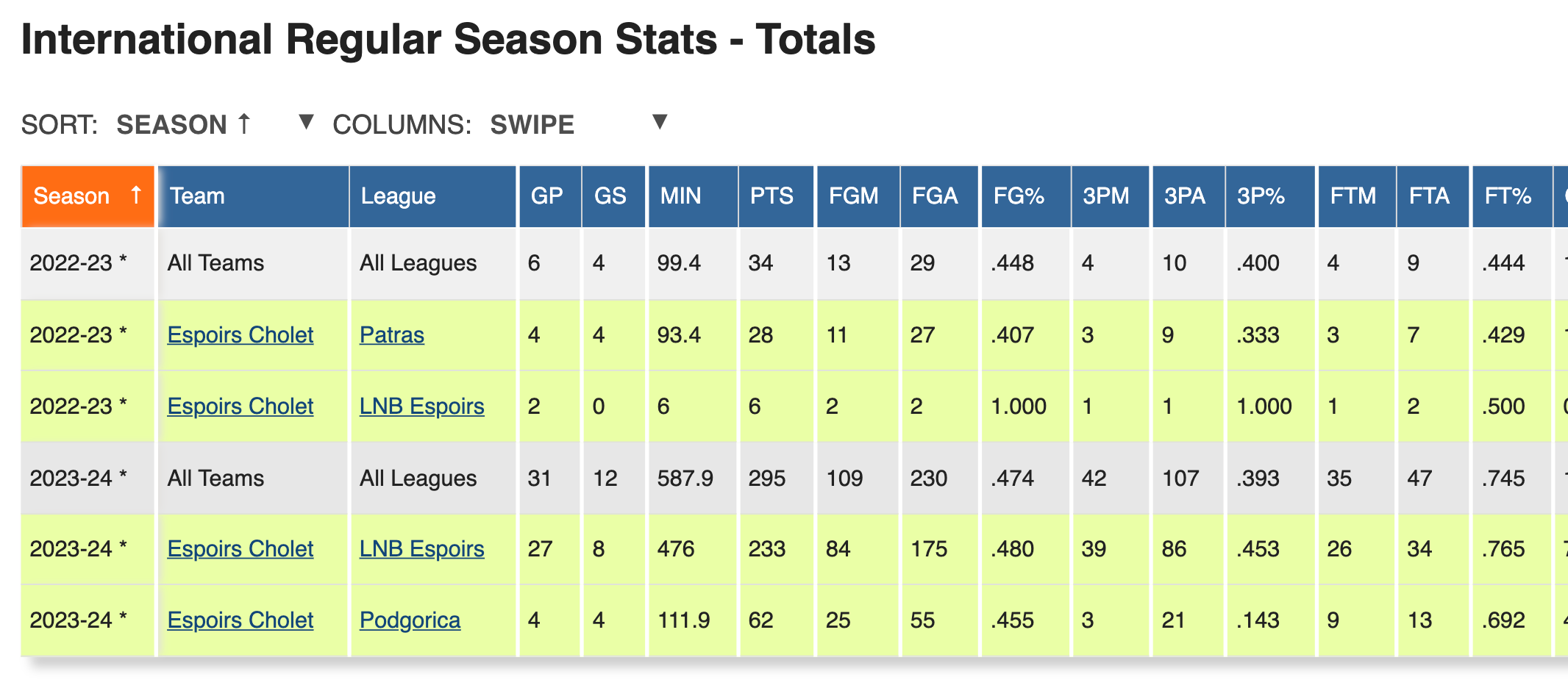
Soren also went 3/21 from 3 in 4 games of Podgorica (an ANGT tourney), which isn’t counted in the aforementioned sample. To summarize, we have a 39/86 3P sample, a 3/21 3P sample, and a 4/33 3P sample. This is just ridiculous variability, and his middling FT just doesn’t give us enough confidence in either direction.
Let’s aggregate all of his 3P shooting, throwing in his 2023 stats for good measure (4/10 3P). 50/150 3P in 837.6 minutes, or 33% 3P in 7.2 3P/40. This isn’t nearly as interesting as his Espoirs’ 45% 3P on 7.2 3PA/40, but the consistent volume is notable.
The absolute biggest red flag in Soren’s profile is his lack of foul drawing. Ajay was a legit good foul drawer at 5.2 FTA/40 in Espoirs, and he followed it up with a career 48 FTR at UCSB. Meanwhile, Soren was at just 2.9 FTA/40 in Espoirs, with a similarly disappointing 19 FTR in Espoirs, and 17 FTR at FIBA U17s. If he’s unable to draw fouls against age-standardized comp, it seems somewhat unlikely that he’s going to do so against grown men in a few years. Ajay was also slightly better inside the arc, shooting 53% 2P on 6 2PA/40, while Soren was at 50.7% 2P on 7.5 2PA.
The severe lack of foul drawing + 51% 2P is why I’m not quite ready to anoint Soren as the next breakout French guard. Coupled with his poor verticality, Soren may have some real issues scoring inside the arc at higher levels. Throw in his highly variable 3P shooting, and that TS% could plummet a lot in the next few years. And even if he’s played more minutes than Ajay, his total minutes stack up poorly to guys like Theo Maledon and Killian Hayes at the same age.
But there are several ways this could go very well. The most compelling argument is that Soren is basically better and more productive at all aspects of basketball than Ajay was at the same age, other than foul drawing. Again, Ajay was absolutely not a standout player at Espoirs, but the extent to which Soren was better at the same age while matching archetype/usage is nonetheless notable. Soren could potentially reach basketball savant territory, given his precocious passing goodness and high steals in both Espoirs + FIBA. He has flashed OTD 3P comfort and rips off a lot of 3s, with decent FT% to boot. There’s some inside the arc concerns, but this guy did just put up a 20 PER + 60 TS season as a 17 year old. Out of the NBA guys, only Killian Hayes did it at a younger age. With a bit of growth, both physically and skill-wise, Soren’s upside tail is quite interesting.
4. Maxence Lemoine
Maxence isn’t as much of a sleeper as these others that I’ve mentioned, but he’s underrated enough for me to discuss here.
Maxence Lemoine vs Soren is far closer than I anticipated, but Maxence is probably a better bet for now. Maxence seems to have more pedigree than Soren, and he almost certainly has a higher floor.
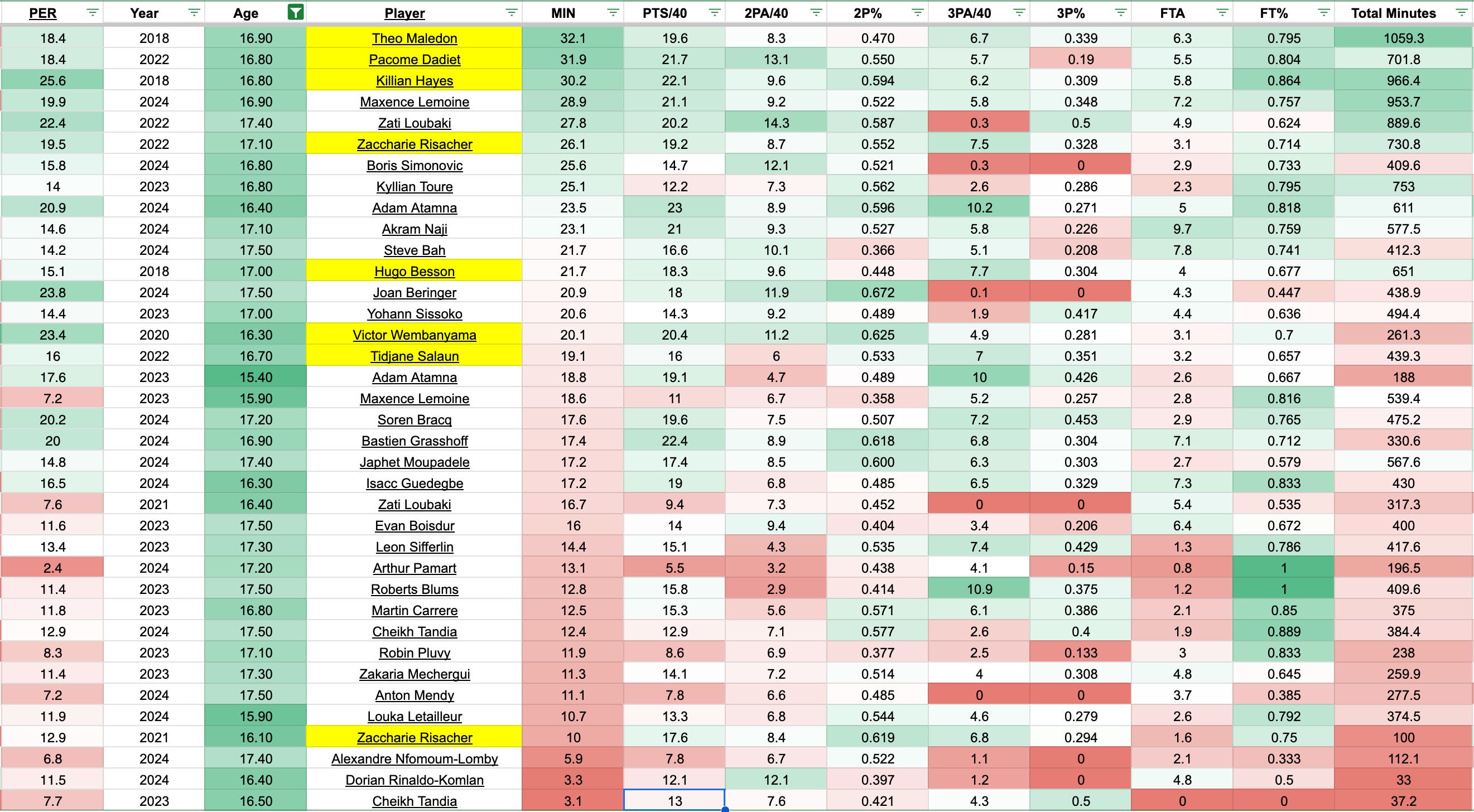
For instance, this is the history of Espoirs players with < age 17.5, sorted by minutes per game. Good company, and even better company if you ignore the complete non-3P shooters. Even if he doesn’t fit the most fascinating archetype, it’s probably sharp to bet on Maxence’s combo of high minutes, Espoir productivity, and age. We can see Maxence played nearly twice as many minutes as Soren did this past season.
The quick pitch for Maxence is that he is literally a Theo Maledon doppelganger.

They are even in nearly every stat while being the exact same age. However, Theo had a bit higher AST% and TO%; Maxence seems more risk averse. Maxence clears in TS%, A:TO, and PER, but again the differences are pretty minimal.

More similarities across the board when comparing scoring. Only clear differences are that Maxence was a more efficient scorer inside the arc, but Theo was a far better defensive rebounder (similar ORB tho). But this rebounding discrepancy is important, because Theo measured at 6’4 with 6’8 WS. Maxence is listed as 6’2, and although his WS does look a decent bit longer based on this video:
Two more observations: Maxence seems pretty controlling operating and scoring out of the PnR, his shooting numbers might be more real than Soren given his relative difficulty of looks.
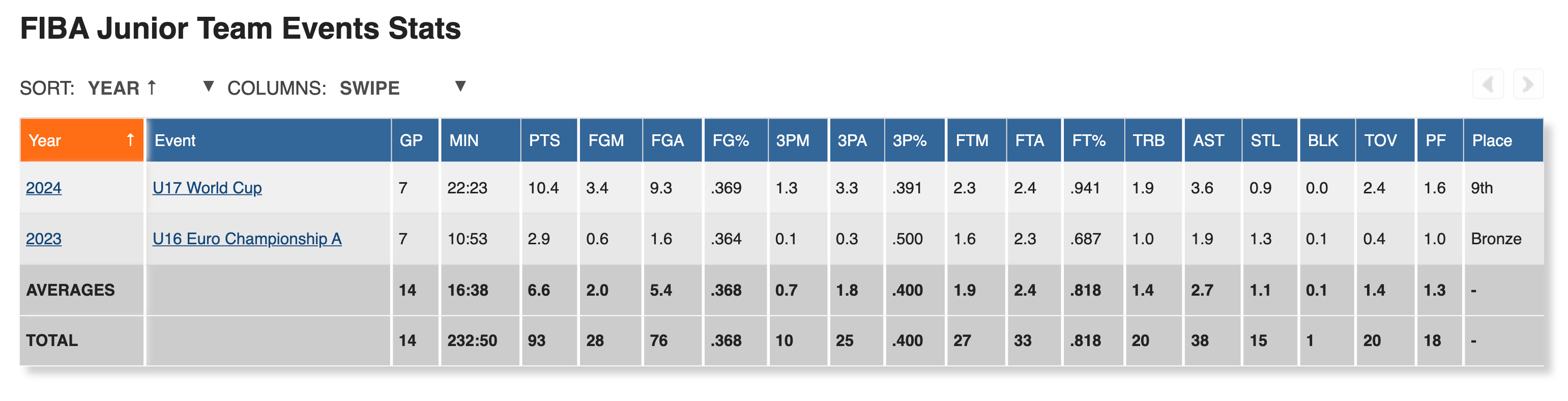
But while he did score more per 40 with slightly higher (but still abysmal) FG%, we can see that Maxence did most of his damage as a 3P shooter. 10/25 (40% 3P) across 14 FIBA games is impressive, but it comes at the cost of just 18/51 (35% 2P). Yikes.
That’s basically what you get with Maxence. He’s a smaller Theo Maledon (Maledon was 6’4 with 6’8 WS, and Maxence seems to be around 6’2), with clear deficiencies as a rebounder (just 3.5 rebounds/40 at FIBA, in line with his 3 rebounds/40 average at Espoirs). Theo was actually a pretty good shooter in the G league (38% 3P across 3 G League seasons), but he was an absolutely abysmal scorer in the NBA who could not shoot from deep, could not score at the rim at all, and achieved multiple sub-50 TS seasons.


Maxence is probably a better finisher and shooter than Maledon, based on the Espoirs numbers, but it’s definitely not guaranteed given Maledon’s superior size, and the statistical difference isn’t really that significant. Theo was definitely a great passer in the NBA (25% AST/16.5 USG in 2023), and he was always a good FT shooter, similar to Maxence.
But this is characteristic of a trend that I’ve noticed a lot with these young French prospects. Whether it’s Killian or Maledon or Ajay, strong precocious FT shooting does not always preclude a 3P shooting leap. These guys had been considered elite FT shooters for so many years without meaningful improvements in 3P shooting; Killian shooting > 85% FT since 16 years old should indicate legit intrinsic touch. The same shooting heuristics just don’t seem to hold the same veracity.
My take is that it’s not as useful to extrapolate 3P% when we have a significant enough sample of poor 3P shooting (many years + many failed attempts). I’ve hinted at this before, but I blamed this phenomenon more on height. This is what I wrote in my Leonard Miller piece a year ago.
Skill: (Size + Touch) + Youth
The “coordination curve” is real. Tall players tend to undergo much more drastic skill improvements than shorter players. This is but another generality, but this is either because 1) the wings have been dominating by virtue of physicality for a while and are thereby at a skill disadvantage or 2) said player has grown immensely over a short period of time and is reaping the benefits of activating newfound avenues of scoring by virtue of increased frame and mass. Leonard may be the rare case that fits in both categories.
This might be intuitive, but young, wing sized players need to be graded on a much less harsh shooting curve- they are most prone to making massive in-season shooting leaps. Just look at Brandon Miller 3P volume/% leap this year, or even Tari Eason’s FT% jump from freshman to sophomore year in 2022. Touch indicators are probably more robust for wings than guards, since the shooting curve is longer for wings. Speaking as someone who had Devon Dotson insanely high, Devon Dotson shooting 80% from the line but only 30% from 3 is not as strong of a shooting bet as someone 6 inches taller than him. Leonard has great touch indicators, he’s 6’10”, and he’s 19 years old. His already strong touch indicators are even more impressive in context of his size and age. He is certainly not destined to be a “bad” shooter.
I think I was cooking with those two possibilities, but what I should have mentioned is that the shooting curve is simply longer for players who aren’t great shooters. A player who has been poorly shooting 3s for a long time, with great underlying numbers, is simply not as good of a bet as a player with similarly encouraging peripherals but not as extensive of a 3P disasterclass history. I blamed this on height, but that’s really just a proxy for the true issue: 3P experience. If there was a “taller” player with a long history of elite shooting volume and elite FT%, but consistently subpar 3P%, then they deserve the same disheartening 3P shooting diagnosis that Devon Dotson/Killian Hayes should have received.
So let’s try a new hypothesis: low 3P experience + strong FT% is the ultimate use-case for FT as a proxy for shooting upside. It remains to be seen how useful this will be, but an interesting study is Nikola Topic, who had a long history of elite FT% but consistently poor C&S 3P% in the last two years. I was more optimistic pre-draft, but I think it’s more likely that he’s a poor to mid shooter for the first half of his career.
This isn’t all directly tied to Maxence, but it does pique my interest in how he develops as a shooter. He seems fluid and coordinated, moreso than Theo did in my NBA watchings. There may be a higher OTD shooting upside with him, which would prolly enable him to shoot better than Theo did in the NBA.
At the end of the day, Theo Maledon is a solidly subpar NBA player, and a “smaller but production doppelganger of Theo Maledon” is not the most inspiring player. But Theo prolly ends up a highly productive guard if he comes back to Europe for the rest of his career. I’m not very optimistic about Maxence’s NBA chances, but he does seem like one of the better players in the current French generation. And an outcome like Maledon would prolly still be greater than current expectation. A real shooting leap, coupled with meaningful physical development, is prolly a standard deviation or two away, but if it hits, he could hit similar outcomes to someone like Goran Dragic.