Allen Graves, Twice
a collaborative piece by @100guaranteed + @freewave3


Allen Graves is a 6’9 freshman forward for the University of Santa Clara. He is one of the most impactful players in the country, and he deserves more attention, particularly in draft spaces.
This is the case, presented by Gavin and Avi.
The Anatomy of a Sleeper
Gavin (@freewave3)
As of late, I’ve found myself looking through the scouting lens differently. How does a prospect impact the game if their shot isn’t falling? I’ve noticed that one of the biggest flaws in the mainstream/consensus realm of the draft is overindexing on a player’s effectiveness because they’re shooting well. This is something we especially see early in a cycle.
Every year, players will shotmake at an absurdly hot rate, and they will find themselves flung into conversations they don’t belong in. Just as frequently, especially when their priors don’t align with their shotmaking, these prospects free-fall back to earth as the sample stabilizes. Outside of the rare cases of an eternal magnetball (the most recent example would be Kon Knueppel), players whose value is heavily reliant on the ball going in naturally tend to have a lower floor, as everyone is prone to cold shooting stretches. Their lack of ancillary value during these times can lead to far more devastating impact compared to other players with cold shotmaking.
Similarly, I feel like too often, people in the scouting sphere get too caught up in chasing scoring-centric“star bets.” Which can be reasonable, but the process usually involves a high usage player with “upside” and “advantage creation”. The pitch is mostly based on their ability to make shots, and it’s a very difficult way to find value on the margins. Year in and year out, we see these imperfect versions of these archetypes fissile out and get replaced with the latest shiny new toy. It’s a vicious cycle, and the high-end versions of these players are usually selected with premium picks.
It is seemingly forgotten that the NBA is built on outliers, particularly those that strongly impact the game outside of scoring. I believe we should primarily be chasing such players, especially when trying to make winning moves at the margins with less premium picks.
This stream of logic is exactly how I found Allen Graves, and how he became my favorite prospect in the class.


It’s almost shameful to admit this, but I felt like there was something secretly wrong with Graves. Something in his profile I was blind to, something that would explain his complete lack of hype.
I initially assumed the red flag was that he was a redshirt freshman. But Graves was born in July 2006, which is right around normal NCAA freshman age.
In reality, this uneasiness was entirely because Graves is nowhere to be seen on boards, and definitely not “approved of” within the consensus. I would search his name on Twitter every few days and see, at best, five total tweets about him in a week. It made me doubt my evaluation. If he is as good as I think he is, why doesn’t anyone else notice?
This leads to another major flaw in the world of scouting: the weight of a player’s consensus rank is far too heavy. You’ll see prospects who completely fall apart during the NCAA season retain their preseason pedigree because of its power. In the same way, if you dislike someone loved by consensus, people default it to being attention-seeking or engagement baiting. No matter how good a profile Graves has this season, it will be an uphill battle for him to get first-round consideration, and it has nothing to do with on-court play and everything to do with arbitrary rankings from Big-Draft. Whenever I put together my next big board and rank Graves above some RSCI darling, the default reply will be presuming malicious intent or hurling insults, not asking why he’s so high or who he is.
The power of consensus is as powerful as anything else; what could a random guy on Twitter possibly know that professional evaluators don’t?
A Primer on the Cognition-Mass Index
Avi (@100guaranteed)
Over the last decade+ of watching the NBA, the most jarring change has been in effective shot quality. Teams take less long 2s than ever, with an increased emphasis on rim attempts and threes. League true shooting and points per possession has trended upward.
It’s led to the formation of a consensus: pretty much all front offices and coaching staffs generally agree on this vision, particularly in the avoidance of “bad shots”.
One of my favorite quotes on consensus in analytics is by sabermetrician Jeff Sullivan:
Numbers are no less powerful than they used to be, but there’s less relative power to be wielded when everyone’s trying. A given front office now would have a massive advantage over an organization run by a bunch of stubborn throwbacks, but such organizations are so near to extinct they’re almost hypothetical. So the comparison doesn’t have any meaning.
While its actual importance is undeniable, there seems to be increasingly little edge in generating “good” shots. The most effective means of finding a new edge must come from diving into the causal mechanics of sport. In other words, diving into the fundamental mechanisms that explain how certain interactions lead to more favorable results than others.
And perhaps the most important, forgotten aspect of sport is it's cognitive architecture.
We have seen an enhanced cognitive economy in basketball. League-wide assist to turnover rates are increasing. Stocks per foul are increasing. Avoiding turnovers is important not just to extend possessions, but because shots off of live ball turnovers are wildly efficient. Mistakes are more costly than ever. Strong cognition, with the primary utility of possession maximization, has trended from premium to prerequisite. But this isn’t nearly as talked about as the rise of “threes”, mainly because cognition isn’t nearly as perceptible as shotmaking.
Cognition-mass index is my evaluation paradigm to approximate size-specific cognitive thresholds. It’s a concept inspired by body-mass index, but with a different target: BMI is a fraction, as there is a middle ground between height and healthy weight. Cognitive-mass index looks for the highest combinations of cognition and mass, and it can best be understood as a product: Cognition X Mass.
Players with high cognition tend to have low applied mass. Think point guards, with the smallest stature and lowest rebounding/blocks. And players with high applied mass tend to have low cognition. Centers crush physicality proxies like rebounding and blocks, but with the lowest passing or steal rates.
This is mostly intuitive. What is more rare are the high cognition, high mass players. I believe that actively seeking out players with an outlier cognition x mass product is the highest EV pathway for effective teambuilding, and it also offers the clearest paradigm for finding undervalued options in prospect evaluation.
This is especially important, as these high cognition x mass players may demonstrate unorthodox styles that lead to their being underrated. Think Nikola Jokic, one of the heaviest players in the NBA and one of its best passers ever. A high-cognition player with large functional weight tends to outperform expectations most significantly.
Searching for players with outlier combinations of cognition and mass is an easy edge, given their fit in a league where cognitive burden is consistently rising.


From a statistical lens, we can look for these outlier cognition x mass prospects by using physicality and cognitive indicators in tandem. And with the “offensive rebounding-assist-stock” query that I first tweeted in 2024, this is uniquely possible. I mentioned in the summer of 2024 how it included some of the most unlikely development stories. Since then, we’ve seen the meteoric collegiate rises of Joshua Jefferson and Dailyn Swain, as well as a recent, surprising NBA “breakout” by Peyton Watson.
To recap, players with strong blends of physicality and cognition are rare, highly useful in today’s cognitive economy, and tend to have strong growth. It is in our best interest to find such players.
A Statistical Anomaly
Gav (@freewave3)
When I found Graves, I was looking for players with strong functional athleticism and a willingness to shoot.
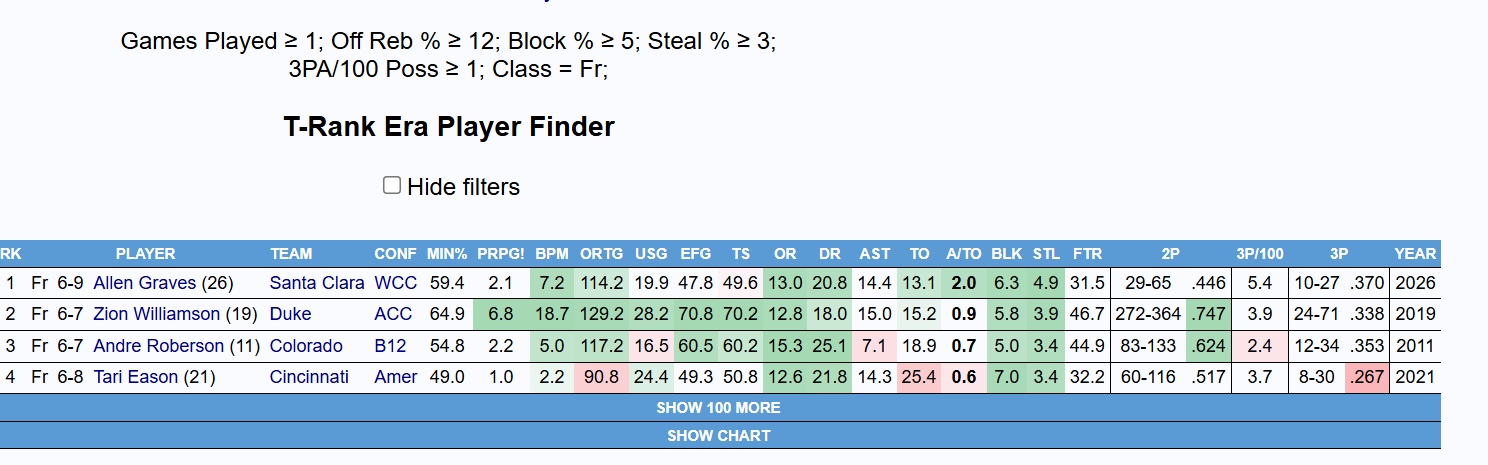
At first, Graves looked like a long shot as a one-and-done NBA prospect. After all, he was a redshirted freshman shooting 38% on non-dunk rim attempts, with a 0 recruit rank. I initially expected him to be a multi-year college player, as his offense was so poor but had some upside comparisons. The most similar freshman profile was freshman Tari Eason, who would post a 13 BPM, 62% TS sophomore season.
Even as a heavily flawed offensive player, I thought that his physicality and stock creation were probably outlier enough to be worth a second-round draft selection, as his baseline skillset is much stronger than the usual master-of-none upperclassmen that find themselves in that range. At the time of my first draft article, Graves and Eason had shockingly similar profiles with similar offensive holes:

And then suddenly, Graves hit another gear. There was no need to wait for his sophomore season to see an offensive leap, as it came at the start of WCC conference play. While a 7-game sample is very small, he has massively improved in every facet of offense while sustaining his monster 10.8% stock rate. Very encouraging production.

My favorite part of Graves’ profile is his ridiculous turnover aversion. The usual price of these world-eater defensive players is low offensive feel. Yet, Graves has been one of the best passers ever for this level of stock creation. He’s nearly down to a single digit TO rate. He has 1 turnover in his last 5 games, and he’s at 2.4 A:TO on the season.
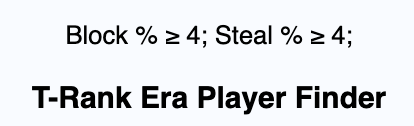
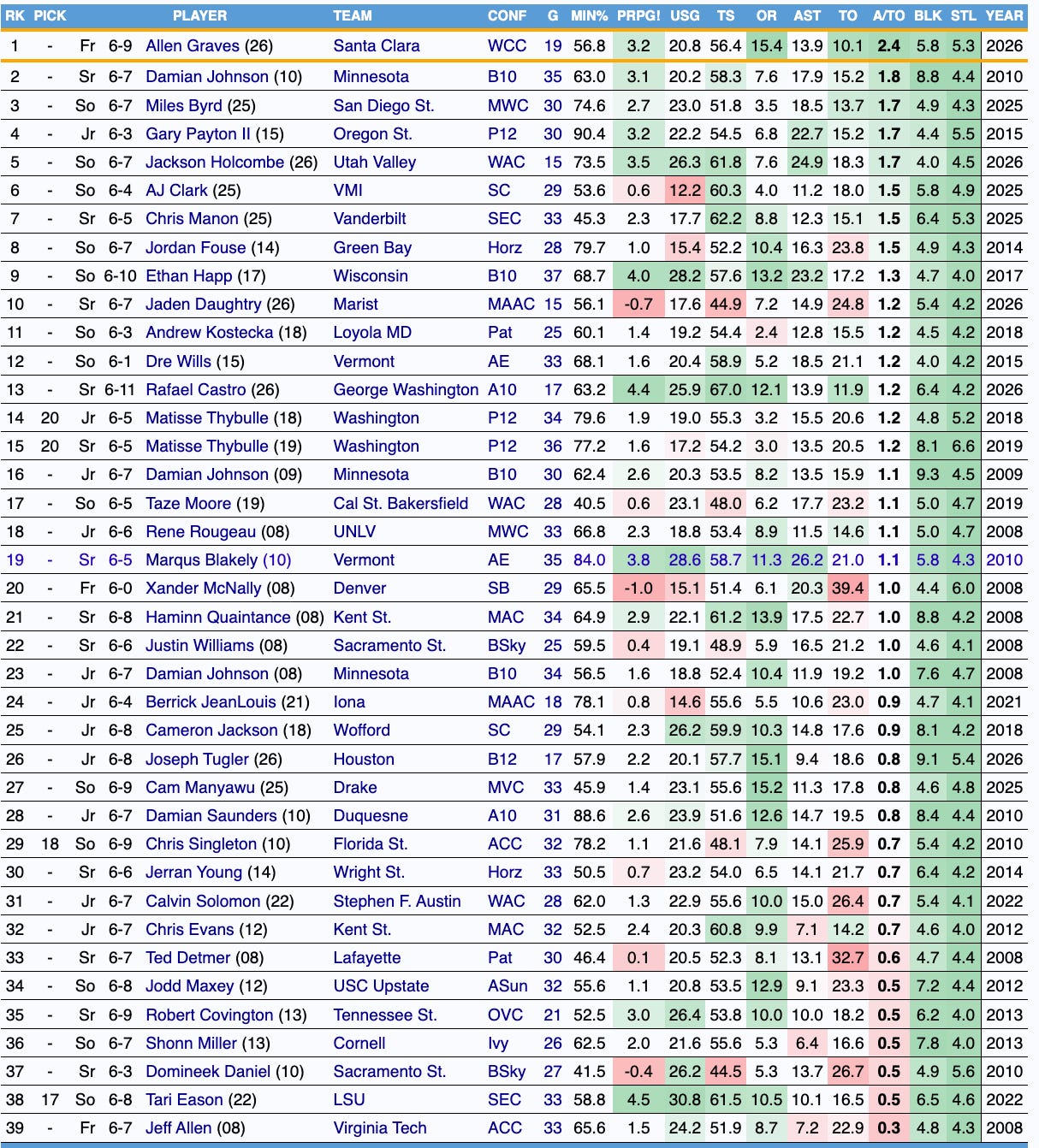
And there isn’t really anything obviously boosting his stock or A:TO.
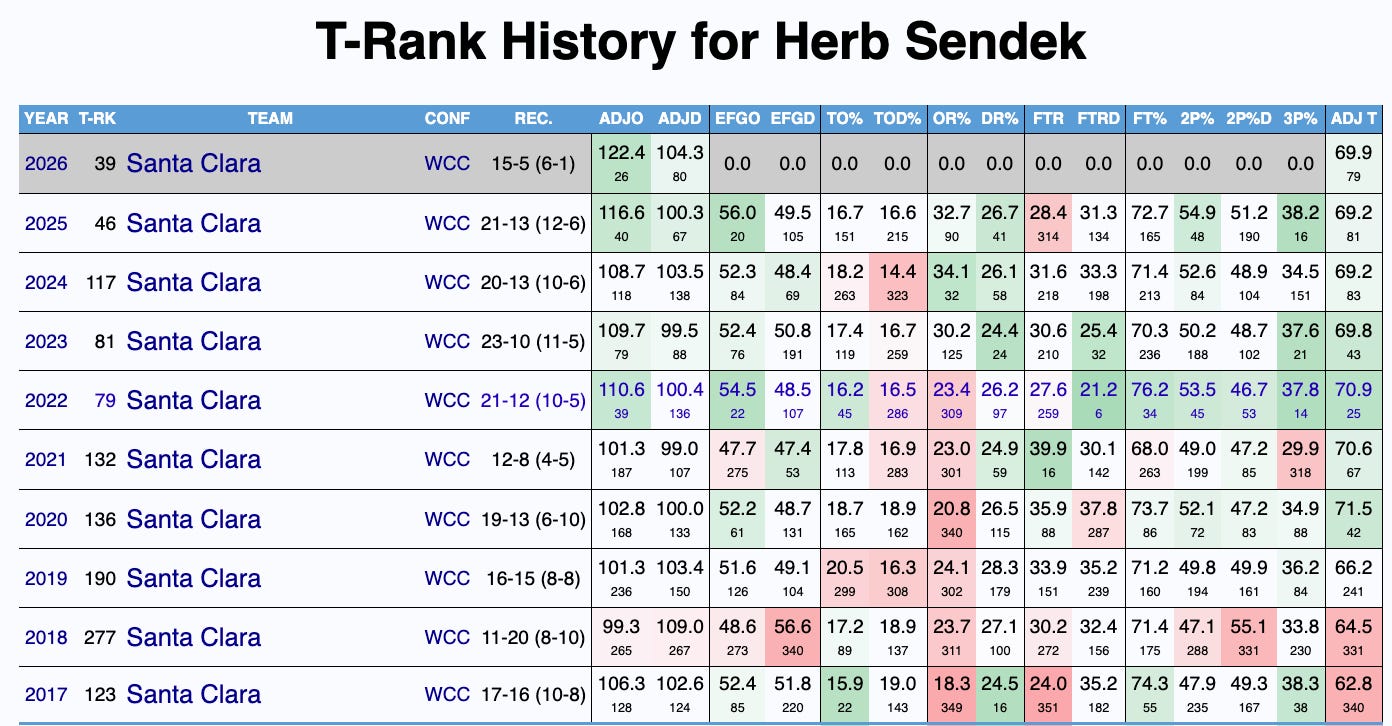
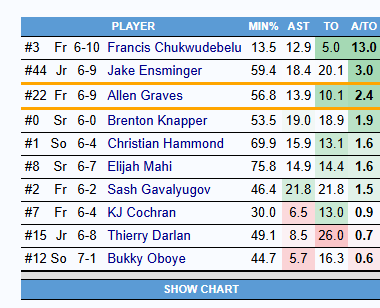
Santa Clara is usually middle of the pack in offensive turnover rate. Graves also has the lowest turnover rate of anyone playing real minutes. He is not system-made.
When we put together his assist to turnover rate and steal rate, we get some wild company. Only 4 others qualified, and none of these players are even close to his height.


Graves has guard-like traits at 6’9 and 225 pounds, with a 7 foot wingspan. In a league where every team is clamoring for an elite defensive wing, I don’t see how an integration like Graves’ isn’t worth a first round pick at least. His feel and physicality is so outlier.
Discerning a Developmental Trajectory
Avi (@100guaranteed)
Graves was certainly not expected to put up a season of this caliber. In fact, he was completely unranked by 247Sports coming out of high school, despite an award-winning high school career.
Ponchatoula 6-foot-10 standout Allen Graves capped his high school career as a leading player on a state championship team for a second year in a row, and for that has been selected as Mr. Basketball by the Louisiana Sports Writers Association.
From this April 2024 article from Nola.com
But for some sharp grassroots scouts, Graves’ EYBL production gave him clear outs to becoming an impact college player.

Graves’ combination of outlier offensive rebounding and steals was especially standout during the 2023 EYBL session. Averaging 2.2 offensive rebounds and 1 steal per game is outlier stuff, and if we filter for out archaic scoring processes (0.66 3Pr+FTr), the list of 2023 qualifiers was just Graves and another severely underranked prospect (Adrian Wooley).
Expanding this list out provides the following names:
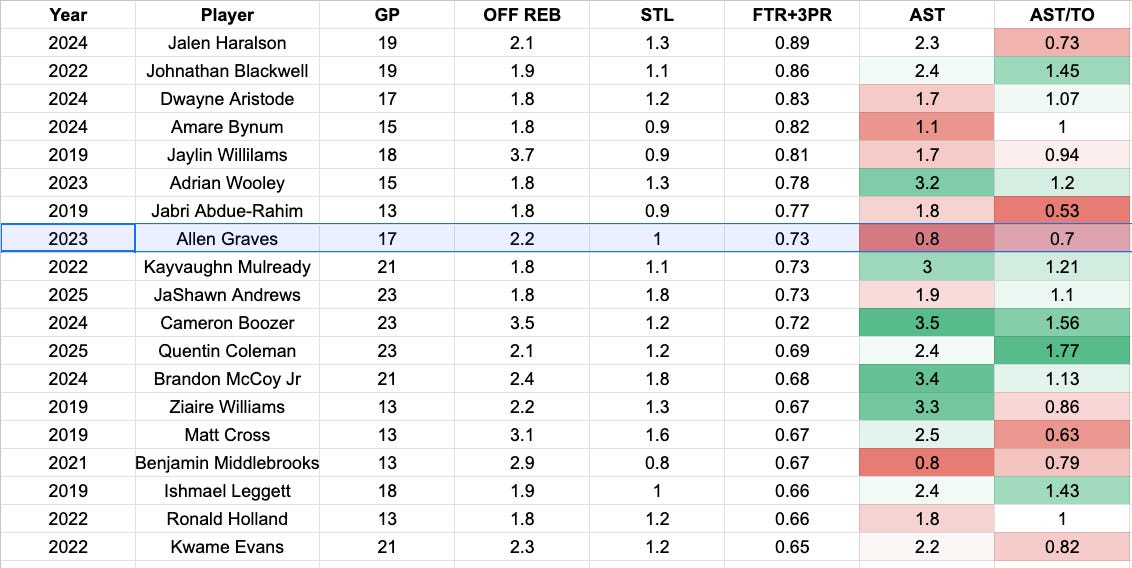
With strong offensive rebounding and steals on the toughest circuit, Graves should have at least been ranked in the early hundreds. The majority of these names were productive college players, and Graves falls near the middle of the pack by each of the three filters.
Graves’ physicality and feel was impressive, but Graves also averaged the 19th ranked assist/game and 18th ranked assist to turnover rate of the 19 listed players. He was comfortably the least efficient passer of the cohort.
Somehow, Graves is now putting up one of the most efficient passing seasons by a freshman forward ever.

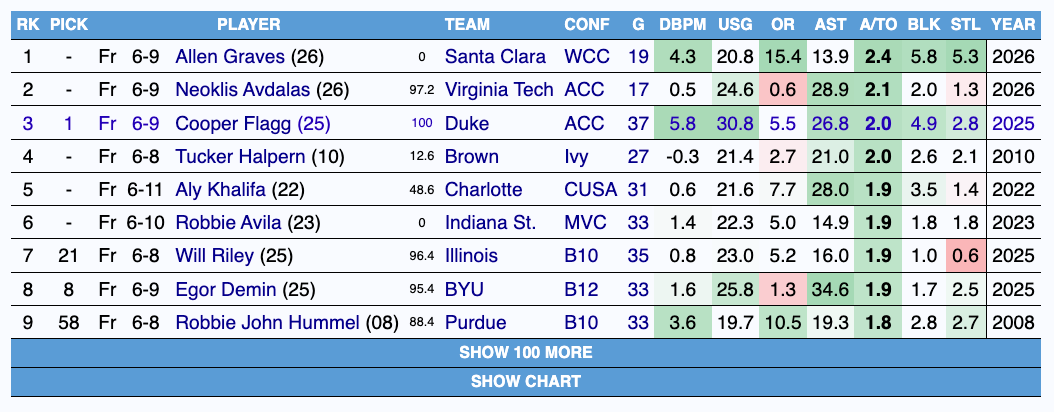
We can also compare Graves’ passing to forwards with perimeter skill that played on respectable teams.
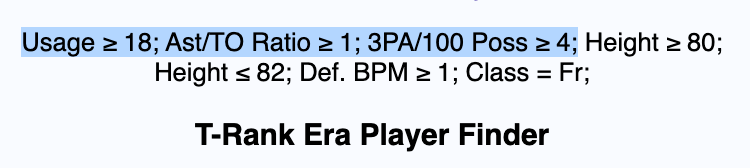
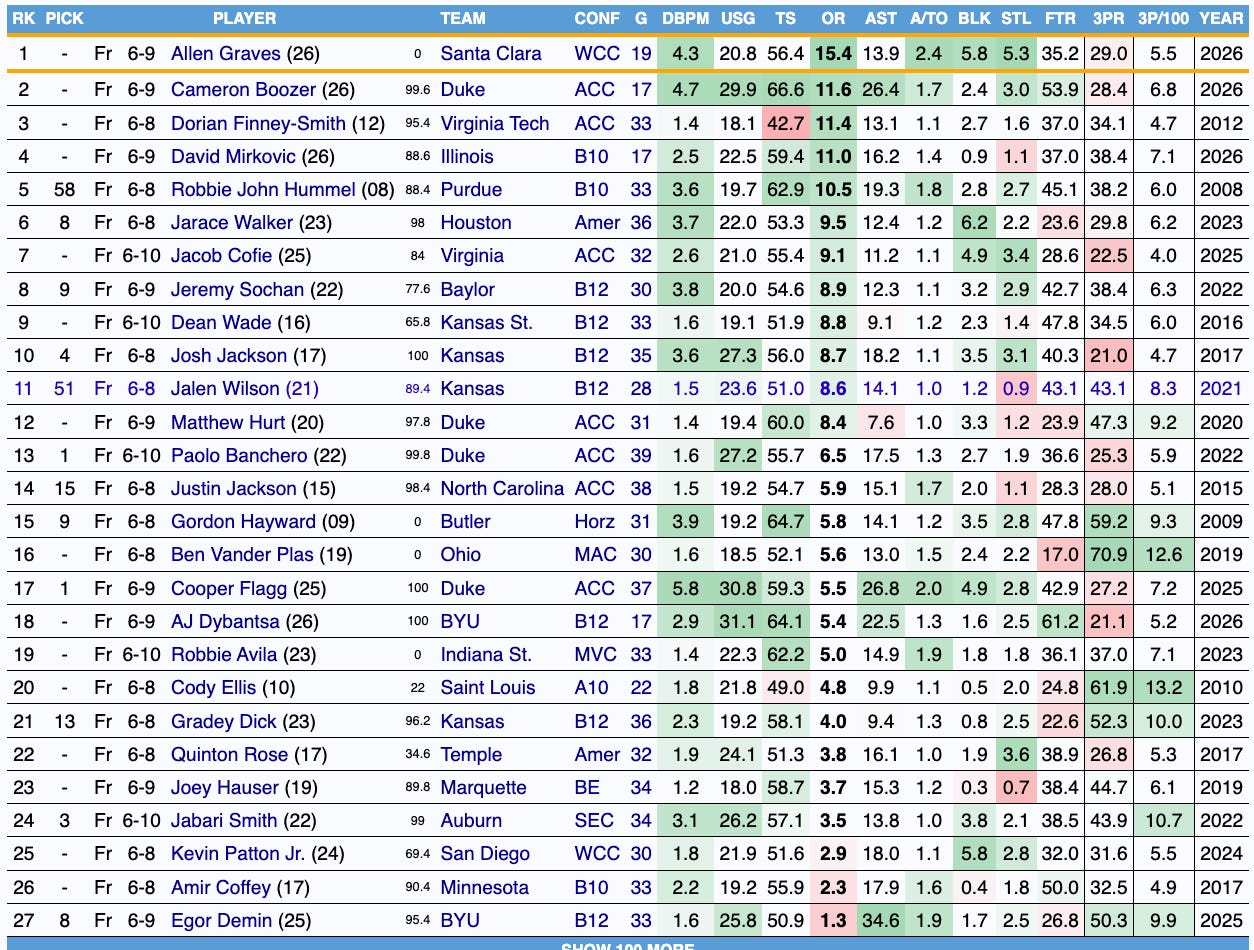
Graves’ ability to absolutely lap this group in offensive rebounding and A:TO, while still getting up a reasonable number of threes, should be commended. In sorting by offensive rebounding, we see a few interesting names. Dean Wade and Dorian-Finney Smith are especially notable considering their RAPM goodness.

Positional preferences do not delineate the on-court impact gods nearly as well as NBA 3Pr. That Wade and Finney-Smith take the majority of their shots from outside the arc is an important point, even though their freshman 3Pr may seem pedestrian.
If we go back to the Bart query, note how inefficient Wade and Finney-Smith were as freshmen. Finney-Smith scored at a horrific 43% TS, while Wade was at 52% TS. In fact, Graves has the highest freshman TS% of any of the NBA players in the screenshot above.
This doesn’t excuse Graves’ finishing badness, but it does offer a potential pathway to positive offensive value. Graves’ 3Pr is not too far off from Wade or Finney-Smith, and we can estimate some suppression given the inverse relationship between offensive rebounding and 3Pr. But Graves’ 3P rate is more in line with Jarace Walker, who got up to 0.5 3Pr in the NBA.
Jarace is woefully inefficient in the NBA, lacking the physicality to efficiently score inside the arc or the touch to convert 3s. Thus, touch development will be crucial for Graves, as it will give him the upside to reliably 3Pr-maxx the way some of his query compatriots did. While touch development is uniquely feasible given his outlier blend of physicality and cognition, it is something to monitor.
In EYBL, Graves was comfortably the worst passer of our OREB/Steal cohort, and just two years later, Graves is putting up some of the most efficient passing we’ve ever seen a freshman forward.
Always bet on outlier blends of physicality and cognition.
It’s fair to be suspicious of this passing leap, but it’s not really anything system-related. Herb Sendek’s Santa Clara teams aren’t exactly known for their turnover aversion. They do rank reasonably year-to-year in assisted rate, but usually outside the top 50.
This is probably just good ole-fashioned development. 17-year-old Allen Graves’ ability to grab offensive rebounds in spite of taking 3s, as well as grab steals at legitimate forward weight, were a testament to his latent cognition. Evaluators should have taken note, but they didn’t bother to even fill out a 247 prospect profile.
It’s the largest discrepancy between AAU production and recruiting rank that I’ve seen. All while he had excellent dimensions and was extremely young for his high school class.
Somehow, Allen Graves was hiding in plain sight.
A Series of Ridiculous Clips
Gav (@freewave3)
By far the biggest thing that has stood out when watching Graves are his hands, especially in passing lanes. I cannot emphasize it enough: Graves’ spatial awareness is absurd, and he makes plays like an NFL CB/Safety. He doesn’t have the craziest wingspan at 7 feet, but the way he weaponizes it matters more to me than the raw measurements.
I’ve compiled a series of clips where Graves’ hands especially stood out to me.
Below are two instances of “pick sixes”, where Graves anticipates an errant pass and brings it all the way to the other end for a rim score. These clips show his strengths (length, feel), but we can also see how Graves isn’t the best vertical athlete.
Graves is a strong passer out of the post, and he makes quick decisions as a connector. He has an insane 2% turnover rate on post-ups including passes. It’s not like he’s padding his A:TO by only making safe passes; Graves is a legit playmaker from the perimeter too. A one-handed live dribble bounce pass at 6’9 is not normal; it’s even better considering we’re taking any flashes of offensive upside that we can get with such a talented defensive specialist.
There are not many 6’9 players who can guard your best player, and then play as an efficient connector from the middle of the floor like this. His court mapping really stands out to me; he’s making these passes so quickly that the defense has very little time to react. Notice how there’s nothing telegraphing where the ball is going, which is unusual from what I’ve seen from players this size.
On top of being one of the best passers and deflection creators at his size, Graves is also an insane rebounder.
What stood out the most when watching Graves’ rebounding is how little he fumbles with the ball. His hands are exceptional, which is a common theme that we’re seeing here.
Most players this effective on the offensive glass will bobble the ball or keep their head down without mapping the landscape; as I’ve repeated so many times, this processing speed for his size is so outlier.
Here, Graves completely manhandles the box-out and, within a half second of turning, he recognizes his teammate cutting and drops a bounce pass through traffic. If you blurred this and told me this was a play by Cameron Boozer, I would believe you. Graves’ motor is so comically extreme that he leaps for the put back the second he sees the ball roll towards the outer rim; he’s going 100 miles per hour while his brain is also processing at 100 MPH.
Even when he’s at a positioning disadvantage or in a 1vsX box out, Graves still finds ways to grab offensive rebounds. The truly elite rebounders always find a way. It’s like the ball is magnetized to him; his reaction time to missed shots allows him to fly from the outskirts of the paint and towards the ball. At the beginning of this clip, he’s sandwiched between 3 players, and there are 4 Gonzaga players closer to the ball than he is. Somehow, against all odds, he’s the one who comes away with the offensive rebound.
This clip below is probably the most extreme example of his motor and awareness. Not only does Graves teleport for the offensive rebound, but he realizes there are 4 defenders in the paint & he throws it out to the perimeter right before he falls the ground.
Insane stuff from one of the very best offensive rebounders I have watched at this college level.
Finally, here is Graves in a 1v4 for the offensive rebound. And again it does not matter because he legitimately has the ball tracking skills of an All-Pro safety; this clip may not even appear to be impressive because this sort of process continuously looks routine for him.
There are so many clips I could have used, but my point would be the same. Graves is physical, has impressive spatial awareness, and has some of the best hands in the country. Doing this as a freshman, at that size, is so outlier.
Future Outlook
Avi (@100guaranteed)
Graves is the ancillary freshman of the decade. He is this year’s face of the aforementioned offensive rebounding/assist/stock query.
His statistical profile exhibits the most ridiculous combination of applied force and cognition that we have seen to this point in the Bart era. No one has ever maxxed out stocks, rebounding, and passing to this degree. Spend 10 minutes on Barttorvik dot com and this will become exceedingly obvious.
Is this an infallible prospect? Absolutely not. Graves is not a particularly good shooter, and a below-average finisher. His scoring process, efficiency, and effectiveness are underwhelming.
And while the bar for requisite offensive impact is low considering his gargantuan defensive impact, it is possible that Graves never even reaches it. Miles Byrd is arguably a smaller version of this distribution, and he has unfortunately not made the upperclassmen leap that many expected. Jarace Walker also had a similar distribution of scoring stats, and an increased NBA 3Pr could not save his multi-level touch deficiencies.
Improved finishing and shooting touch will be critical to form a legitimate, high impact NBA case. And Graves obviously needs to maintain this torrid pace to some degree.
Still, it gets to a point. This is outlandish, historic-tier ancillary impact, with a feel/physicality distribution that is strongly high EV.
Graves simply has no peer in the Bart era. In fact, we’d have to use Stathead to identify the only college player has hit 11 rebounds, 3 steals, 3 assists, and 1.5 A:TO on a per-40 basis across a season. It was Ron Harper during his 1989 senior year at Miami (OH). Graves is on pace for 12.7 rebounds, 3.7 steals, 3.4 assists, and 2.4 A:TO, as a freshman.
Ancillary impact is sticky, and it gives Graves a unique floor. Offensive development would asymmetrically skyrocket his stock, but the novelty of this distribution is still NBA-caliber.
Graves maintaining this pace would imply that he is strongly draftable this year, quite reasonably in the first round. At the least, this is a clear breakout candidate that will play NBA minutes at some point, likely of the high-leverage variety.
While this may seem hot for a player with zero recruiting pedigree and no appearances on any mock or big boards, we are highly optimistic in the NBA future of Allen Graves.
Great piece…
annoyed that you guys did this because I was thinking about doing a Graves breakdown for this week. Good find and good work.